


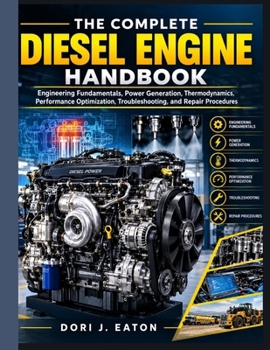
The Complete Diesel Engine Handbook: Engineering Fundamentals, Power Generation, Thermodynamics, Performance Optimization, Troubleshooting, and Repair

Book Description
Have you ever stood in front of a diesel engine, listened to it idle, and realized you couldn't actually explain why it sounds the way it does?
If you've ever opened a service manual looking for answers and found yourself buried in torque specs with no explanation of what's actually happening inside the cylinder, or sat through a textbook chapter on thermodynamics that never once connected back to the engine sitting in your shop, you already know the problem this book was written to solve.
Diesel engines power more of the world than most people realize. They move freight across continents, keep hospitals running when the grid fails, push ships across oceans, and pull equipment through fields and quarries where nothing else could do the job. And yet the knowledge needed to truly understand them has always been scattered. Academic texts explain the physics but rarely touch the hardware. Repair manuals walk you through procedures but never explain the reasoning behind them. Forums offer scattered advice that may or may not apply to the engine actually in front of you.
So where does that leave you if you want to actually understand diesel engines, not just memorize steps?
This handbook was built to close that gap, from the ground up.
It starts with the fundamentals, how compression ignition actually works, why it differs so completely from spark ignition, and why that difference shapes everything else about how these engines are built and operated. From there, it moves into the thermodynamics that govern combustion efficiency, explained in a way that connects the equations directly to what's physically happening inside a running cylinder. You'll work through engine architecture in genuine depth, covering blocks, pistons, crankshafts, valve trains, and cylinder heads, understanding not just what each part does but why it's built the way it is.
From there, the book moves into the systems that define modern diesel technology: fuel injection from mechanical pumps through today's electronically controlled common rail systems, turbocharging and forced induction, cooling and lubrication, and the emissions control technology that every modern engine now depends on to meet current regulations. You'll find a full chapter dedicated specifically to power generation, covering generator sizing, load response, and the technical details of running multiple units together reliably, along with dedicated coverage of marine propulsion and industrial applications.
And then comes the part most books skip entirely or treat too lightly: real diagnostic reasoning.
Rather than handing you a list of symptoms matched to guesses, this book teaches you how to actually think through a problem, how to move from a reported symptom to a confirmed root cause using a structured, repeatable process. You'll find detailed coverage of fuel system diagnostics, turbocharger fault analysis, electrical and sensor troubleshooting, and how to read smoke color, noise, and vibration like the diagnostic signals they actually are. The same depth carries through into full overhaul and rebuild procedures, covering teardown, measurement, reconditioning, and reassembly with the kind of precision a genuine rebuild demands.
Maintenance strategy gets its own serious treatment as well, including how to build a service program that actually fits how your equipment is used, how to read and act on oil analysis results, and how to think about total cost of ownership rather than just the next repair bill. And because this field keeps moving, the book closes by looking ahead, covering hybrid diesel systems, emerging fuel technologies, and where diesel power is actually headed as the industry continues to evolve.
Customer Reviews
ThriftBooks ® and the ThriftBooks ® logo are registered trademarks of Thrift Books Global, LLC
