


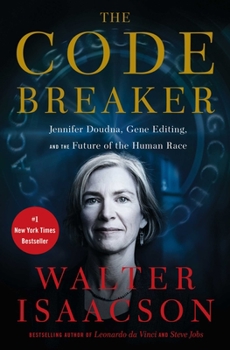
The Code Breaker: Jennifer Doudna, Gene Editing, and the Future of the Human Race


Select Format
Select Condition 
Book Overview
A Best Book of 2021 by Bloomberg BusinessWeek, Time, and The Washington Post The bestselling author of Leonardo da Vinci and Steve Jobs returns with a "compelling" (The Washington Post) account of how Nobel Prize winner Jennifer Doudna and her colleagues launched a revolution that will allow us to cure diseases, fend off viruses, and have healthier babies. When Jennifer Doudna was in sixth grade, she came home one day to find that her dad had left a paperback titled The Double Helix on her bed. She put it aside, thinking it was one of those detective tales she loved. When she read it on a rainy Saturday, she discovered she was right, in a way. As she sped through the pages, she became enthralled by the intense drama behind the competition to discover the code of life. Even though her high school counselor told her girls didn't become scientists, she decided she would. Driven by a passion to understand how nature works and to turn discoveries into inventions, she would help to make what the book's author, James Watson, told her was the most important biological advance since his codiscovery of the structure of DNA. She and her collaborators turned a curiosity of nature into an invention that will transform the human race: an easy-to-use tool that can edit DNA. Known as CRISPR, it opened a brave new world of medical miracles and moral questions. The development of CRISPR and the race to create vaccines for coronavirus will hasten our transition to the next great innovation revolution. The past half-century has been a digital age, based on the microchip, computer, and internet. Now we are entering a life-science revolution. Children who study digital coding will be joined by those who study genetic code. Should we use our new evolution-hacking powers to make us less susceptible to viruses? What a wonderful boon that would be! And what about preventing depression? Hmmm...Should we allow parents, if they can afford it, to enhance the height or muscles or IQ of their kids? After helping to discover CRISPR, Doudna became a leader in wrestling with these moral issues and, with her collaborator Emmanuelle Charpentier, won the Nobel Prize in 2020. Her story is an "enthralling detective story" (Oprah Daily) that involves the most profound wonders of nature, from the origins of life to the future of our species.
Format:Hardcover
Language:English
ISBN:1982115858
ISBN13:9781982115852
Release Date:March 2021
Publisher:Simon & Schuster
Length:560 Pages
Weight:2.12 lbs.
Dimensions:1.7" x 6.4" x 9.5"
Customer Reviews
1 rating
Bleh… Flashy Pop Science
Published by bachocat , 1 month ago
Having previously enjoyed the author’s biographical work, I eagerly purchased this book expecting a detailed biography of Jennifer Doudna. While it does briefly explore her childhood curiosity and her journey in overcoming gender barriers in science, the narrative swiftly pivots to an extensive exploration of CRISPR-Cas9’s development, the intense lab rivalries, patent disputes, contributions from other scientists, its applications during the COVID-19 pandemic, and the associated ethical dilemmas.
Mr Isaacson’s presentation is often dragging and bone dry. He frequently mirrors the field’s exaggerated claims, branding CRISPR as precise gene editing and suggesting that scientists have essentially deciphered the code of life. However, our comprehension of the genome remains limited, with scant knowledge about the majority of genes and their intricate interactions. The use of metaphors such as “editing” and “programming” can be misleading, fostering a CSI effect where entertainment takes precedence over factual accuracy. Complex diseases like Alzheimer’s or most cancers are not merely simple “fixable errors” akin to rare single gene disorders. The book attempts to portray Doudna in a heroic light but spreads itself too thinly across the collaborative and competitive dynamics of the field.
Mr Isaacson’s narrative style favors storytelling over nuance. The ethical discussions are repetitive, the scope is excessively broad, and his depiction of scientific competition appears either oversimplified or biased. It’s flashy pop science that emphasizes the revolution without sufficient humility regarding the complexity of biology.
I was hoping for a more personal biography and was very disappointed. I purchased the book new through a local bookstore. I feel as though I’ve squandered 35 bucks on scientific hype.
Copyright © 2026 Thriftbooks.com
Terms of Use | Privacy Policy | Do Not Sell/Share My Personal Information | Cookie Policy | Cookie Preferences | Accessibility Statement
ThriftBooks ® and the ThriftBooks ® logo are registered trademarks of Thrift Books Global, LLC
ThriftBooks ® and the ThriftBooks ® logo are registered trademarks of Thrift Books Global, LLC
