


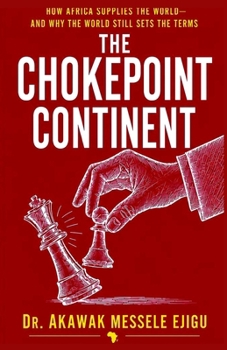
The Chokepoint Continent

Relevance Is Not Power
Africa supplies many of the resources the modern world depends on-minerals essential to electric vehicles, renewable energy, telecommunications, and defense. Its forests shape global climate policy. Its population represents one of the largest future labor forces and consumer markets. Its ports, digital users, and strategic geography influence governments and corporations worldwide.
Yet Africa rarely controls the systems that turn those assets into wealth and influence. Minerals come from African soil, but prices are set on exchanges elsewhere. African users generate vast data, but the platforms and algorithms extracting value from it are controlled abroad. African forests produce valuable carbon assets, while external institutions define how they are measured, certified, and priced.
Africa matters. But mattering is not governing.
In The Chokepoint Continent, Dr. Akawak Messele Ejigu explains why Africa's growing global importance has not produced proportional power. Possession alone does not create leverage. A country may control a valuable mineral, a major port, or a critical ecosystem and still remain dependent if others control the systems through which that asset moves.
Those systems are the chokepoints: commodity exchanges, refining networks, payment rails, cloud platforms, shipping corridors, standards bodies, carbon registries, arbitration forums, and debt calendars. Less visible than mines and pipelines, they determine who sets the price, controls timing, grants access, and writes the rules.
The book identifies four forms of leverage: Positional-controlling something scarce and hard to replace. Architectural-controlling the system through which others must operate. Temporal-the capacity to wait and negotiate without forced concessions. Admissibility-controlling standards and regulations that determine access.
Africa holds significant positional leverage. The challenge is converting that position into architecture, protecting it with time, and extending it into rule-making authority.
The book traces how the present system was built-from colonial extraction corridors and structural adjustment to global finance, digital platforms, and infrastructure competition-showing how formal sovereignty can coexist with operational dependence.
But this is no book of fatalism. It does not argue Africa is powerless or that all foreign engagement is exploitation. African governments have agency. Some have built institutions that convert resources into bargaining power. Others have traded long-term control for short-term revenue.
The decisive question is not whether Africa should participate in global markets, but whether participation builds African capacity-or merely expands African activity inside systems governed by others.
The book offers a practical doctrine: identify what others cannot easily replace, build the systems through which that value moves, extend financial and political time horizons, and gain influence over rules of entry. That means investing not only in roads and mines, but in laboratories, data centers, payment systems, geological intelligence, regulatory institutions, regional markets, and standards bodies.
The Chokepoint Continent is a sharp examination of hidden global power architecture-and a strategic argument for how Africa can move from relevance to leverage, from participation to authority, and from supplying the world to helping set its terms.
Related Subjects
Business Business & Investing Economics Political Science Politics & Social SciencesCustomer Reviews
ThriftBooks ® and the ThriftBooks ® logo are registered trademarks of Thrift Books Global, LLC
