


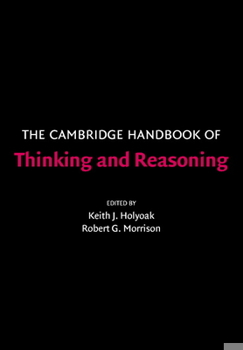
The Cambridge Handbook of Thinking and Reasoning


Select Format
Select Condition 
Book Overview
The Cambridge Handbook of Thinking and Reasoning is a comprehensive and authoritative 2005 handbook covering all the core topics of the field of thinking and reasoning. Written by the foremost experts from cognitive psychology, cognitive science, and cognitive neuroscience, individual chapters summarize basic concepts and findings for a major topic, sketch its history, and give a sense of the directions in which research is currently heading. The volume also includes work related to developmental, social and clinical psychology, philosophy, economics, artificial intelligence, linguistics, education, law, and medicine. Scholars and students in all these fields and others will find this to be a valuable collection.
Format:Paperback
Language:English
ISBN:0521531012
ISBN13:9780521531016
Release Date:April 2005
Publisher:Cambridge University Press
Length:858 Pages
Weight:3.38 lbs.
Dimensions:1.6" x 7.1" x 9.9"
Customer Reviews
2 ratings
Comprehensive Overview of the Theories, Research, Concepts and Results
Published by Thriftbooks.com User , 18 years ago
This book is comprehensive. For anyone interested in psychology, thinking, analogical, spatial and other types of reasoning, this book is excellent. It categorizes and summarizes the basic concepts on thinking. It goes into what the latest research is telling us. It has great diagrams of processes and concepts that I found useful and interesting. If one is interested in becoming a better and smarter thinker, I would highly recommend this book. It is not for the feignt of heart. It is in fact probably geared specifically for cognitive, psychological or other scholarly audiences (i.e., it is a technical book for the specialist in the field). I recommend it however for the generalist - like me - who is interested in becoming a better thinker, a better reasoner, and a better decision maker.
Excellent
Published by Thriftbooks.com User , 18 years ago
Philosophy and psychology offer very different contributions to human knowledge, due in part to their different strategies for arriving at the truth but also due to the extent to which they are accepting of scientific facts and theories. Philosophers like to believe that their opinions, argumentation, and writings are more fundamental than scientific theories and serve as a "foundation" for the latter. Psychology on the other hand is usually more empirical, but still does not hesitate to build models, many of them abstract and sometimes seeming far removed from the (mental) phenomena they are supposed to represent. But since psychology does at times have some contact with laboratory experiments, it can be said to be closer to science than philosophy is. Only a tiny minority of those who profess to be philosophers would make any efforts in the laboratory experiments. This distinction between philosophy and psychology can sometimes fade if one investigates their account of human reasoning which is well-represented in the articles that are included in this book. Covering a wide range of opinions on the nature and functioning of human thought, readers will no doubt be selective as to what articles they actually go over in detail. This was the case for this reviewer, who was primarily interested in the articles that make a connection with cognitive neuroscience. It is the latter field that is making contact with both philosophers and psychologists, and both parties have found themselves deeply involved in debates over topics such as the "modularity" of mind and the sometimes bitter disputes over the independence of neuronal synapses and cognition. Philosophers of mind usually build elaborate theories based on sophisticated rhetoric in order have a framework to "justify" or criticize human reasoning abilities, and some psychologists construct "mental models" of the same. But if these systems of rhetoric or models are to be helpful to the cognitive neuroscientist, there has to be a way to test them experimentally. This has been very difficult until the advent of magnetic resonance imaging, and the article "Cognitive Neuroscience of Deductive Reasoning" by V. Goel in this book gives an excellent overview of the experiments that have used this technique to study deductive reasoning patterns. Early on in the article he outlines what he says are the two most popular psychological theories of deductive reasoning: the "mental logic" and "mental model" theories. He also mentions another, the "dual mechanism" theory that has been recently proposed. Goel then outlines the brain experiments that have been conducted that will verify (falsify) these theories and the discussion is very illuminating. It is very exciting indeed that the ancient syllogisms of Plato and Aristotle are now being explained by brain science, especially the identification of the areas of the brain that are responsible for analyzing the "validity" of logical arguments. Goel remarks that
Copyright © 2026 Thriftbooks.com
Terms of Use | Privacy Policy | Do Not Sell/Share My Personal Information | Cookie Notice | Cookie Preferences | Accessibility Statement
ThriftBooks ® and the ThriftBooks ® logo are registered trademarks of Thrift Books Global, LLC
ThriftBooks ® and the ThriftBooks ® logo are registered trademarks of Thrift Books Global, LLC
