The final masterpiece from the celebrated author of Crime and Punishment and The Idiot ... This extraordinary novel, Dostoyevsky's last and greatest work, tells the dramatic story of four brothers--Dmitri, pleasure-seeking, impatient, unruly . . . Ivan, brilliant and morose . . . Alyosha, gentle, loving, honest . . . and the illegitimate Smerdyakov, sly, silent, cruel. Driven by intense passion, they become involved in the brutal murder of their own father, one of the most loathsome characters in all literature. Featuring the famous chapter, "The Grand Inquisitor," Dostoyevsky's final masterpiece is at once a complex character study, a riveting murder mystery, and a fascinating examination of man's morality and the question of God's existence. Translated by Constance Garnett Edited and with a Foreword by Manuel Komroff and an Afterword by Sara Paretsky
Wonderful written characters, with deep philosophical themes
By Luis H, August 26, 2026
Verified Purchase
This book was honestly fun and the characters were enjoyable. The weakest point is near the end, but the characters are what make this story. It is hilarious at times and deeply thought-provoking. This is a book. I will probably think about for a long time to me not as good as crime and punishment, but it is a fantastic book nonetheless.
0
★☆☆☆☆
Book arrived falling apart
By Avery, July 1, 2026
Verified Purchase
No extra care taken in packaging. I understand it’s an old book but to say this is very good quality is a lie, it was damaged before shipping and damaged from shipping and I will be pursuing a refund/return.
2
★★★★★
it’s a classic for a reason
By cjb, April 1, 2026
Verified Purchase
i usually go for shorter books so this felt like a big undertaking for me, but i ended up reading it fairly quickly because i couldn’t get enough.
6
★★★★☆
One of the Classics
By Nick, July 1, 2024
Verified Purchase
Worth reading.
5
★★★★★
Landmarks The Brothers Karamazov
By Thriftbooks.com User, July 4, 2009
excellent condition for the price, I'm hoping the book will take me deeper in one of my favorite novels, that I've read twice
5
★★★★★
Greatest Book Ever
By Thriftbooks.com User, June 20, 2009
My three criteria for Great Book candidates are that they must be deep intellectually, stunning in character development, and beautifully written. This book is unequaled in all three ways. It states the argument against the existence of God based on evil, and the appeal of worldliness, as well as I've ever seen, then epitomizes those ideas in characters and plot, and then does pretty well developing counterarguments on all those levels. The Magic Mountain and Dr. Faustus by Thomas Mann, lots of Sartre and Camus, and actually quite a few other novels, personify but don't particularly argue ideas [very well, at least]; Ayn Rand's Atlas Shrugged, on the other hand, is powerful and catchy and does argue, but her favored characters are mostly one-dimensional facets of her philosophy, which is so extreme that her envisioned opponents end up being straw men. The accuracy of her images of opposed views cannot be defended seriously. Dostoyevsky's characters are archetypes, but with multiple dimensions and realism, who engage in real conversation and resultant temptations to waver [though not as deeply as Bakhtin claims]. Dostoyevsky gives a rounded description before each main character appears, but then the character, in dialogue, bursts into a colorful reality. The writing is complex and yet gripping--reading it in high school was pretty hard, but then picking it up in college, I could not put it down, except to rest. It sometimes seems to wander but is constantly building, and its digressions turn out to be amazing constructions. I've come back to my Constance Garnett translation again and again. I've only read pieces of one or two others [and I cannot read Russian], but Garnett seems as skillful and consistent as any in expressing [seemingly] Dostoyevsky's views and vision of the Russian soul. That soul does contain, regrettably, anti-semitism, anti-catholicism, nationalism, and anti-modernism, and Dostoyevsky transmitted them all. But, except for the anti-modernism, which he argues forcefully, these views obnoxiously mar the book but aren't essential to its amazing argument or structure. Compared with the fine books on many 10 or 100 best lists, this one is a sun competing with floodlights.
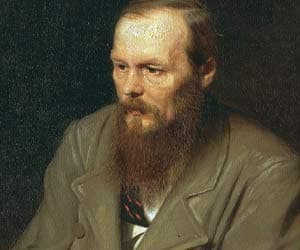
Fyodor Dostoyevsky's successful first book, Poor Folk, came out 175 years ago today when the author was only 24 years old. But in a life beset by drama worthy of, say, a Russian novel, it would be many years before he produced a notable follow-up. Here we explore the literary giant’s best books and how they mirror his extraordinary life.
The Cannes International Film Festival has been postponed, along with just about everything else! Are we feeling a little bleu about it? Mais, oui! Nonetheless, we can find consolation in les livres. C’est la vie!