


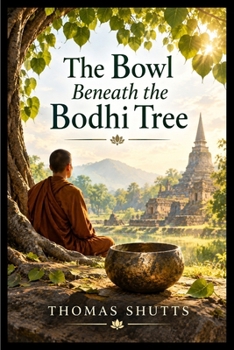
The Bowl Beneath the Bodhi Tree

Beckett Hayes has spent ten years as a novice archivist at a remote mountain monastery, finding comfort in the dead order of the Relic Repository. Surrounded by cracked bells, broken censers, damaged scripture cases, and forgotten liturgical objects, he prefers things whose histories can be measured, cataloged, and safely placed in the past. The living world is more difficult. Compassion, responsibility, and unresolved suffering demand choices that Beckett has spent years avoiding.While clearing an ancient drainage culvert beneath the Great Shrine, Beckett uncovers a damaged bronze bell buried in decades of mud. Beneath its heavy skirt he discovers an unusual alms bowl, an apparently ancient patra coated in a black lacquer unlike anything he has previously cataloged. The surface absorbs the light of his tallow lamp so completely that the inside appears less like a physical vessel and more like a bottomless opening.An archaic inscription beneath the grime offers a disturbing warning: "What you see is what your karma has already begun." Beckett initially explains it as a conventional moral teaching, the kind of admonition once used to remind monks that an alms bowl reflects the intentions of both giver and receiver. Yet his skepticism begins to collapse when he places several grains of cold rice into the bowl.The rice does not simply disappear. The black surface begins to move like liquid, and Beckett is suddenly transported into a terrifying sensory vision. The cold repository is replaced by burning cedar, smoke, collapsing timber, and a violent fire. Within the darkness he sees a bronze oil lamp, a desperate hand, and hears a voice crying his ordained name-Minh An-and warning him to look to the gates.The vision ends as abruptly as it began. Beckett returns to the repository with the bowl apparently unchanged, yet the taste of soot remains in his mouth and the memory of the voice refuses to fade. Rational explanations become increasingly difficult as the message begins to connect with events beyond the monastery walls.The bowl becomes a mirror for Beckett's deepest conflict. He has used monastic discipline as protection from suffering, hiding among artifacts because broken things require cataloging rather than compassion. But the warning from the bowl forces him toward the very responsibilities he has avoided.As the mystery deepens, Beckett must determine whether the vessel is revealing the past, warning of the future, or simply exposing truths he has refused to see. His encounter with it transforms the Relic Repository from a refuge into a threshold. The dead objects surrounding him are no longer safely finished histories; they are fragments of consequences still moving through the lives of the living.The bowl beneath the ancient shrine ultimately becomes a test of whether knowledge has any value when it is kept safely locked away. Beckett must leave the security of detached observation and face the human consequences waiting beyond the monastery gates.
Customer Reviews
ThriftBooks ® and the ThriftBooks ® logo are registered trademarks of Thrift Books Global, LLC
