


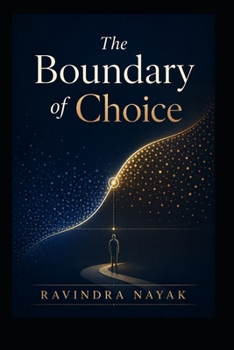
The Boundary of Choice: Logistic Regression from First Principles
No Customer Reviews

Many books introduce logistic regression with a formula. This one begins with a choice.
Will a customer respond? Should a machine be inspected? Is a transaction unusual? Does a learner need timely support? These questions do not ask for an exact number. They ask us to weigh imperfect clues, estimate possibility, and decide where action should begin.
The Boundary of Choice is a fear-free, first-principles guide to logistic regression for complete beginners, non-technical professionals, students, managers, educators, career changers, and curious readers who want genuine understanding without being buried under code or advanced mathematics.
Step by step, the book reveals the full decision chain: features become weighted evidence; weighted evidence becomes a score; the logistic curve turns that score into a probability; and a threshold turns probability into a class or action. Every mathematical idea arrives only after its human purpose is clear.
Inside this book, you will learn how to: distinguish a number-prediction problem from a classification problem;choose useful features and understand what a model can-and cannot-see;interpret weights, the intercept, raw scores, probability, odds, and log-odds;understand the logistic or sigmoid curve without beginning with intimidating notation;set decision thresholds and examine false positives, false negatives, precision, recall, calibration, and workload;build a transparent logistic classifier by hand, one calculation at a time;see how error, loss, gradients, learning rate, repetition, validation, and regularisation help a model learn;recognise overfitting, class imbalance, data leakage, unstable features, bias, distribution shift, and unsuitable uses;apply the ideas responsibly in customer work, maintenance, education, healthcare, finance, agriculture, and operations;create a model card, evaluation plan, monitoring loop, and human-review policy for a small classification system.The explanations are carried by ordinary situations, visual reasoning, natural dialogues, hand-worked examples, reflection prompts, original poetry, reader laboratories, and an extensive Value Edition that turns revision into active brain training. The final workshops help you compress complex ideas, divide difficult problems into manageable chunks, test your own reasoning, and build a complete small classifier responsibly.
No programming experience is required. No confidence in advanced mathematics is assumed. The book does not treat probability as certainty or a model score as permission. Fairness, monitoring, human judgement, limits, and accountability are woven into the learning journey from the beginning.
By the final page, logistic regression will no longer feel like a mysterious equation. You will be able to explain why the method exists, how it turns clues into probabilities, how thresholds change decisions, where errors enter, when the model fits the problem, when it fails, and when the wisest choice is not to automate at all.
Start with one ordinary question. Follow the evidence. Find the boundary. Learn to choose with clarity.
Will a customer respond? Should a machine be inspected? Is a transaction unusual? Does a learner need timely support? These questions do not ask for an exact number. They ask us to weigh imperfect clues, estimate possibility, and decide where action should begin.
The Boundary of Choice is a fear-free, first-principles guide to logistic regression for complete beginners, non-technical professionals, students, managers, educators, career changers, and curious readers who want genuine understanding without being buried under code or advanced mathematics.
Step by step, the book reveals the full decision chain: features become weighted evidence; weighted evidence becomes a score; the logistic curve turns that score into a probability; and a threshold turns probability into a class or action. Every mathematical idea arrives only after its human purpose is clear.
Inside this book, you will learn how to: distinguish a number-prediction problem from a classification problem;choose useful features and understand what a model can-and cannot-see;interpret weights, the intercept, raw scores, probability, odds, and log-odds;understand the logistic or sigmoid curve without beginning with intimidating notation;set decision thresholds and examine false positives, false negatives, precision, recall, calibration, and workload;build a transparent logistic classifier by hand, one calculation at a time;see how error, loss, gradients, learning rate, repetition, validation, and regularisation help a model learn;recognise overfitting, class imbalance, data leakage, unstable features, bias, distribution shift, and unsuitable uses;apply the ideas responsibly in customer work, maintenance, education, healthcare, finance, agriculture, and operations;create a model card, evaluation plan, monitoring loop, and human-review policy for a small classification system.The explanations are carried by ordinary situations, visual reasoning, natural dialogues, hand-worked examples, reflection prompts, original poetry, reader laboratories, and an extensive Value Edition that turns revision into active brain training. The final workshops help you compress complex ideas, divide difficult problems into manageable chunks, test your own reasoning, and build a complete small classifier responsibly.
No programming experience is required. No confidence in advanced mathematics is assumed. The book does not treat probability as certainty or a model score as permission. Fairness, monitoring, human judgement, limits, and accountability are woven into the learning journey from the beginning.
By the final page, logistic regression will no longer feel like a mysterious equation. You will be able to explain why the method exists, how it turns clues into probabilities, how thresholds change decisions, where errors enter, when the model fits the problem, when it fails, and when the wisest choice is not to automate at all.
Start with one ordinary question. Follow the evidence. Find the boundary. Learn to choose with clarity.
Format:Paperback
Language:English
ISBN13:9798190375152
Release Date:January 1
Publisher:Independently Published
Length:326 Pages
Weight:0.87 lbs.
Dimensions:0.8" x 6.0" x 9.0"
Customer Reviews
0 rating
Copyright © 2026 Thriftbooks.com
Terms of Use | Privacy Policy | Do Not Sell/Share My Personal Information | Cookie Policy | Cookie Preferences | Accessibility Statement
ThriftBooks ® and the ThriftBooks ® logo are registered trademarks of Thrift Books Global, LLC
ThriftBooks ® and the ThriftBooks ® logo are registered trademarks of Thrift Books Global, LLC
