


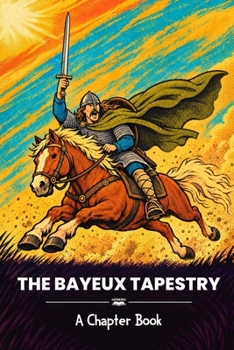
The Bayeux Tapestry: A Chapter Book

England had three kings in 1066. This chapter book follows Harold from his journey to Normandy and the oath he swore there, two years before, to his death at Hastings.
Along the way it names its tellers: the Bayeux Tapestry, the English monks' Chronicle, William's chaplain, a monk in Normandy named Orderic, and a Norse saga written down in Iceland about 160 years later. They were on different sides and do not always agree. Where they differ, from why Harold swore his oath to how he died, the book says so and names the one it follows.
The arrow in Harold's eye shows how a story grows. It does not appear in the earliest written accounts; it enters the record decades later. Children follow it into two later copies of the tapestry: a copy printed in 1730 shows a thin line where the arrow is, and one drawn between 1816 and 1819 shows it with feathers.
Because the tapestry tells William's side, the book tells what it leaves out, including Harold's victory over the king of Norway at Stamford Bridge, less than three weeks before Hastings.
The book tells that battle from the other sources instead. In the saga, an English rider offers the Norwegian king "seven feet of English ground, or as much more as he is taller than other men."
The last chapter follows the cloth itself: nearly 70 metres of linen, shown in Paris while Napoleon planned his own invasion of Britain, and in 2026 carried across the sea to the British Museum in London.
Battles and grief are told plainly and without gore, and none of the 22 black-and-white illustrations shows blood or anyone dying. Tricky names come with a guide to saying them, such as Tostig (TOSS-tig).
Ages 6-10 - 94 content pages - About 9,400 words - 22 black-and-white illustrations - Chapter book
Content note: Includes battles, killing, drowning, burned villages, death, and grief.
Also available for Ages 0-4 (A Toddler Book) and Ages 3-7 (A Picture Book).
Customer Reviews
ThriftBooks ® and the ThriftBooks ® logo are registered trademarks of Thrift Books Global, LLC
