


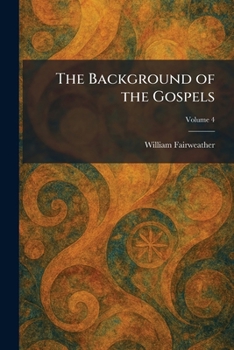
The Background of the Gospels

Select Format
Select Condition 
Book Overview
"The Background of the Gospels" provides a comprehensive exploration of the historical, religious, and literary environment that shaped the world of the New Testament. William Fairweather meticulously examines the crucial period between the Old and New Testaments, focusing on the development of Judaism and the various external influences that defined the cultural landscape into which Jesus was born.
This scholarly work is an essential study for those seeking to understand the socio-political and spiritual forces-such as the rise of Hellenism and the impact of the Maccabean struggle-that directly influenced the early Christian movement. Fairweather's analysis delves into the shifts in Jewish thought, the rise of religious sects, and the evolving expectations regarding the Messiah. By bridging the gap between the two testaments, the book offers invaluable insights into the continuity and transformation of religious tradition.
Readers will find a detailed investigation of the Apocryphal literature, the internal developments of the Jewish church, and the broader context of the Greco-Roman world. "The Background of the Gospels" remains a significant contribution to biblical scholarship, offering a clear and detailed perspective on the historical foundations of the Christian faith.
This work has been selected by scholars as being culturally important, and is part of the knowledge base of civilization as we know it. This work was reproduced from the original artifact, and remains as true to the original work as possible. Therefore, you may see the original copyright references, library stamps (as most of these works have been housed in our most important libraries around the world), and other notations in the work.
This work is in the public domain in the United States of America, and possibly other nations. Within the United States, you may freely copy and distribute this work, as no entity (individual or corporate) has a copyright on the body of the work.
As a reproduction of a historical artifact, this work may contain missing or blurred pages, poor pictures, errant marks, etc. Scholars believe, and we concur, that this work is important enough to be preserved, reproduced, and made generally available to the public. We appreciate your support of the preservation process, and thank you for being an important part of keeping this knowledge alive and relevant.
Customer Reviews
ThriftBooks ® and the ThriftBooks ® logo are registered trademarks of Thrift Books Global, LLC
