


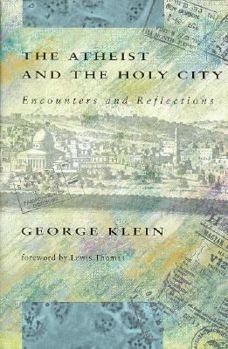
Atheist and the Holy City: Encounters and Reflections

Select Format
Select Condition 
Book Overview
Revised This description may be from another edition of this product.
Format:Hardcover
Language:English
ISBN:0262111551
ISBN13:9780262111553
Release Date:January 1
Publisher:MIT Press
Length:238 Pages
Weight:1.17 lbs.
Dimensions:0.8" x 6.3" x 9.3"
Customer Reviews
3 ratings
Holy Atheist
Published by Thriftbooks.com User , 23 years ago
This is one of those books that I remember by where I read it as much as by what I read in it. A treacherous winter flight between Ottawa and Halifax complete with a skid upon landing and beside me an Anglican minister somewhat fixated upon the title. Now the contents, written by a `spiritual atheist' who has served the planet in his attempt at saving those imperilled by cancer, will be of interest to anyone who values life and humour. I have since read everything he has written for the layman and have wondered about the `Advances in Cancer Research Vol.#' works though I know he must contribute to those differently. _Pieta_ is, perhaps, its equal. Hopefully others may discover this writer, as I was lucky enough to have done.
Critique of REASON
Published by Thriftbooks.com User , 24 years ago
This book takes you throug the depths of reasoning from different angles viz. science, philosophy, spirituality, humanity and more. And the ultimate aim: how ther are just different parts of the same string. Must read !!
A Personal Journey
Published by Thriftbooks.com User , 26 years ago
With this debut collection of essays, George Klein, Holocaustsurvivor and one of the world's foremost cancer researchers has joinedthe growing list of scientists willing to share their experiences in science with the general reading public. By all accounts, this is an impressive start. The essays range in content from personal anecdotes about science and scientists, travelogues, discussions on virology, genetics and cancer, misuses of science in Nazi extermination camps to reflections on death, religion and ethics. His writing is simple, unpretentious, original and a delight to read. If this gem of a collection is any indication of things to come, we are in for many such treats in the future. Read it, enjoy it, treasure it, this book is a memorable reading experience.Not since I read Sir Peter Medawar's essays on science and scientists have I encountered such clarity in language and thought and a commitment to portray science as it is really practiced, subject to the same motivations and biases as any other human endeavor. The first section of the book, "The Wisdom and Folly of Scientists" deals with such issues. The tempo and style of Klein's writing is defined early in the book in the essay "The Emperor's New Clothes" (my favorite in this collection). In this story he explains the phenomenon of scientific "conformism", the tendency of scientists to accept or reject a new finding without critical thinking, and how this may hinder or even damage scientific research. In the essay "Are Scientists Creative" Klein uses the biologist Sol Speigelmann's dilemma, Is my work worth anything? (Something that many scientists must have agonized over at some point) to explore the nature of scientific creativity and to contrast it with the artistic temperament. In "Ultima Thule" he talks to the German geneticist Benno-Muller Hill about the ugly history of the eugenics movement and its culmination in the mass murder of Jews. How could this have happened? How could respectable scientists commit such unspeakable misuses of science? Were they all psychopaths? Klein discovers some surprising answers. One would have thought that after the excesses of the Second World War and our current understanding of genetics, the theory of genetic inequality would have been finally put to rest. Instead, this distasteful topic keeps surfacing every now and then. H.J Muller's 'genetic deterioration' hypothesis, our attitudes towards AIDS patients and Singapore's "race improvement" program through preferential matrimony are recent examples of such misguided thinking. Will we ever shake ourselves free of these prejudices? Klein offers no easy answers, just a warning to keep vigil.In the section Viruses and Cancer, Klein displays his abilities to explain the difficult concepts of virology, genetics and cell biology in uncomplicated and understandable language. The essay "The Tale of the Great Cuckoo Egg" is particularly fascinating. It traces the history of cancer research, from t
Copyright © 2026 Thriftbooks.com
Terms of Use | Privacy Policy | Do Not Sell/Share My Personal Information | Cookie Policy | Cookie Preferences | Accessibility Statement
ThriftBooks ® and the ThriftBooks ® logo are registered trademarks of Thrift Books Global, LLC
ThriftBooks ® and the ThriftBooks ® logo are registered trademarks of Thrift Books Global, LLC
