


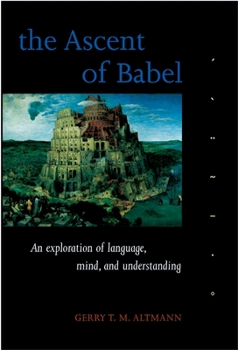
The Ascent of Babel: An Exploration of Language, Mind, and Understanding


Select Format
Select Condition 
Book Overview
The brain holds some 10 billion neurons, an truly amazing number. But taken one at a time, there is nothing amazing about a nerve cell. If you stimulate one, it will stimulate other neurons to which it is connected. And that is all that a neuron does. And yet arising from this great mass of simple cells is every one of our mental faculties, including perhaps the most marvelous of all, our use of language. How do neurons take tiny vibrations on the ear drum and somehow capture meanings about the world? How does the brain understand written words and how does it form a reply? In The Ascent of Babel, psycholinguist Gerry Altmann offers a state-of-the-art look at what we now know about the miracle of language.
Here is a wide ranging, engaging tour of how we use language. Altmann begins even before we are born, revealing that the fetus in the last trimester is already listening to the language of its parents and that, within days of birth, it can distinguish its parents' language from other languages. He discusses the incredible progress the child makes in language recognition (expanding from 100 words at age one to some 60,000 words by adulthood) and he looks at the neural activity involved in language perception, revealing for instance that the pattern of neural activity evoked by a sentence like "the bald man ate a big fish" is probably quite similar to that evoked by actually seeing a bald man eat a big fish. There is an illuminating section on spoken language, highlighting some of the differences between various tongues (English has some 12,000 syllables, for example, while Japanese uses fewer than 120, which explains why Japanese words tend to have many syllables). Altmann shows how errors we make when speaking--such as malapropisms and spoonerisms (garbled utterances such as "The lord is a shoving leopard")--can tell us much about how we plan and execute a spoken sentence, and he explores what happens when the brain misfunctions, as it does in aphasia, dyslexia, and other forms of language deficit, such as Pure Word Deafness (where patients can read, write, and speak normally, but can't understand words spoken to them). Finally, in one of the most intriguing sections of the book, the author provides a fascinating account of recent experiments in artificial neural networks, describing how scientists simulate neuronal activity on a computer, and explaining why their results seem to provide an alternative to the theories of Noam Chomsky about innate structures in the brain.
The Ascent of Babel is a journey of discovery, illuminating how, through the workings of the brain, we use language to reach out and touch each other's minds. Up to date, authoritative, and engagingly written, it will be must reading for everyone curious about the mysteries of language or of the mind.
Here is a wide ranging, engaging tour of how we use language. Altmann begins even before we are born, revealing that the fetus in the last trimester is already listening to the language of its parents and that, within days of birth, it can distinguish its parents' language from other languages. He discusses the incredible progress the child makes in language recognition (expanding from 100 words at age one to some 60,000 words by adulthood) and he looks at the neural activity involved in language perception, revealing for instance that the pattern of neural activity evoked by a sentence like "the bald man ate a big fish" is probably quite similar to that evoked by actually seeing a bald man eat a big fish. There is an illuminating section on spoken language, highlighting some of the differences between various tongues (English has some 12,000 syllables, for example, while Japanese uses fewer than 120, which explains why Japanese words tend to have many syllables). Altmann shows how errors we make when speaking--such as malapropisms and spoonerisms (garbled utterances such as "The lord is a shoving leopard")--can tell us much about how we plan and execute a spoken sentence, and he explores what happens when the brain misfunctions, as it does in aphasia, dyslexia, and other forms of language deficit, such as Pure Word Deafness (where patients can read, write, and speak normally, but can't understand words spoken to them). Finally, in one of the most intriguing sections of the book, the author provides a fascinating account of recent experiments in artificial neural networks, describing how scientists simulate neuronal activity on a computer, and explaining why their results seem to provide an alternative to the theories of Noam Chomsky about innate structures in the brain.
The Ascent of Babel is a journey of discovery, illuminating how, through the workings of the brain, we use language to reach out and touch each other's minds. Up to date, authoritative, and engagingly written, it will be must reading for everyone curious about the mysteries of language or of the mind.
Format:Paperback
Language:English
ISBN:0198523777
ISBN13:9780198523772
Release Date:September 1998
Publisher:OUP Oxford
Length:272 Pages
Weight:0.95 lbs.
Dimensions:0.7" x 6.2" x 9.2"
Customer Reviews
1 rating
Very good, but might be a little dated.
Published by Thriftbooks.com User , 21 years ago
Linguistics is the science of language, and psycho-linguistics is a branch of psychology attempting to understand how we acquire and process language, both oral and written. While this is a book about psycho-linguistics, it provides the reader with the necessary background in the relevant areas of linguistics. Psycholinguistics utilizes a variety of inputs: some very clever experimental tools, both high tech and low tech; studies of individuals with brain damage of some kind; computer investigations of artificial intelligence. Most amazing are the experiments with infants only a few days old. Gerry writes very clearly, and employs just enough repetition to reinforce ideas without being boring. Notwithstanding his efforts, and the significant progress that has been made, psycholinguistics at this point still seems to be more a collection of intriguing conclusions and experiments than a coherent whole. A previous reviewer mentioned that his Tower of Babel analogy adds nothing, and I quickly learned to skip his references to the Tower, but this is a very minor point. I found some of the sentences Gerry used for illustrating points more convoluted than I would have liked, but perhaps that was necessary. I had always thought I would be interested in linguistics, but while the book's discussions of linguistics were interesting, especially on the differences between languages, Gerry left me with no great desire to read another book on the subject, which was a disappointment. In summary, a very good book, but written in 1997, so perhaps a more recent book would be better.
Copyright © 2025 Thriftbooks.com
Terms of Use | Privacy Policy | Do Not Sell/Share My Personal Information | Cookie Policy | Cookie Preferences | Accessibility Statement
ThriftBooks ® and the ThriftBooks ® logo are registered trademarks of Thrift Books Global, LLC
ThriftBooks ® and the ThriftBooks ® logo are registered trademarks of Thrift Books Global, LLC
