


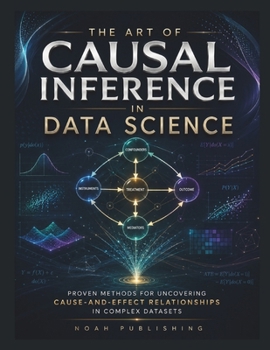
The Art of Causal Inference in Data Science: Practical Methods for Treatment Effects, Causal Graphs, Observational Studies, Regression, Propensity Sco

Data can show that two things happen together without proving that one caused the other. A marketing campaign may coincide with higher sales. A medical treatment may be associated with better outcomes. A new product feature may appear to increase customer engagement. But what if something else caused the change?
The Art of Causal Inference in Data Science is a practical introduction to the methods used to move beyond simple association and ask the harder question: What actually caused the outcome?
Seeing a pattern is not the same as proving a causeModern data science has become exceptionally good at finding patterns, making predictions, and identifying relationships. Yet prediction alone cannot always tell you what will happen when a decision, treatment, policy, or intervention changes.
This is where causal inference becomes essential.
Written for readers who want to understand causal reasoning without becoming overwhelmed by unnecessary technical complexity, this book explains how researchers and data professionals approach cause-and-effect questions using structured study designs, statistical methods, causal graphs, counterfactual thinking, and careful evaluation of assumptions.
You will learn how to distinguish correlation from causation, define meaningful causal questions, identify treatments and outcomes, recognize confounders, mediators, and colliders, and use Directed Acyclic Graphs to make causal assumptions clearer.
The book then moves into practical estimation techniques, including:
Average and individual treatment effectsRegression adjustmentMatching techniquesPropensity scoresWeighting and covariate balanceInstrumental variablesDifference-in-DifferencesRegression Discontinuity DesignSynthetic Control MethodsSensitivity analysisReproducible analytical workflowsStatistical programming for causal projectsReal-world examples connect these methods to business, marketing, healthcare, public policy, economics, education, product development, manufacturing, and machine learning.
Better decisions require better evidenceA misleading relationship can lead to an ineffective marketing campaign, an inaccurate policy recommendation, an inappropriate treatment decision, or a costly business investment.
The problem is not always a lack of data. Sometimes the problem is asking the wrong question of the data.
This book helps you develop the reasoning required to examine alternative explanations, recognize sources of bias, evaluate assumptions, select appropriate analytical methods, and communicate causal findings without claiming more than the evidence supports.
Whether you are beginning your study of causal analysis or looking for a practical reference for real-world projects, the goal is the same: to help you make stronger decisions from data by understanding what the evidence can-and cannot-tell you.
Start asking better questions of your dataIf you want to move beyond simply identifying patterns and learn how to investigate the forces behind observed outcomes, The Art of Causal Inference in Data Science gives you a structured foundation for doing so.
Start reading today and develop a more disciplined way to think about cause, evidence, interventions, and decisions.
Related Subjects
Business Business & Investing Computers Computers & Technology Math Mathematics Science & MathCustomer Reviews
ThriftBooks ® and the ThriftBooks ® logo are registered trademarks of Thrift Books Global, LLC
