


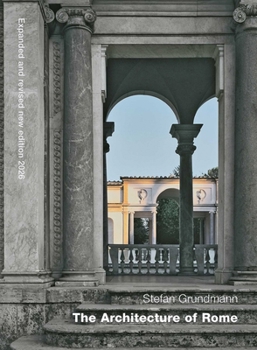
The Architecture of Rome: An Architectural History in 414 Individual Presentations
No Customer Reviews

Dies ist die dritte, erweiterte und berarbeitete Auflage des Rom-Reisef hrers. Neu ist der QR-Code auf der R ckseite, der zu Google Maps von Rom f hrt und alle besprochenen Sehensw rdigkeiten anzeigt. Neben pr zisen Standortinformationen erleichtert diese Funktion die Routenplanung und bietet zus tzliche, aktuelle Informationen wie
ffnungszeiten, Eintrittspreise usw. Architects and artists have always acknowledged over the cen-
turies that Rome is rightly called the eternal city . Rome is eternal
above all because it was always young, always in its prime . Here
the buildings that defined the West appeared over more than 2000
years, here the history of European architecture was written.
The foundations were laid even in ancient Roman times, when
the first attempts were made to design interiors and thus make
space open to experience as something physical. And at that time
the Roman architects also started to develop building types that
are still valid today, thus creating the cornerstone of later Western
architecture. In it Rome's primacy remained unbroken - whether
it was with old St. Peter's as the first medieval basilica or new
St. Peter's as the building in which Bramante and Michelangelo
developed the High Renaissance, or with works by Bernini and
Borromini whose rich and lucid spatial forms were to shape Ba-
roque as far as Vienna, Bohemia and Lower Franconia. When
Louis Kahn, one of the greats of 20th-century architecture, confes-
sed: My mind is full of Roman greatness , this no longer applies
only to those times. For three decades, absolutely central buildings
have been emerging again in the eternal city. From museums to
sacred buildings to large music and event centers: Rome today
has true landmarks of the present day - from Renzo Piano to Jean
Nouvel and Zaha Hadid.
All this is comprehensible only if it is presented historically, i. e.
in chronological sequence, and therefore the guide has not been
arranged topographically as usual but chronologically. This means
that one is not led in random sequence from a Baroque building to
an ancient or a modern one, but the historical development is fol-
lowed successively. Every epoch is preceded by an introduction
that identifies its key features. This produces a continuous, lavish-
ly illustrated history of the architecture of Rome - and thus at the
same time of the whole of the West. Practical handling is guaran-
teed by an alphabetical index and detailed maps, whose informa-
tion does not just immediately illustrate the historical picture, but
also makes it possible to choose a personal route through history.
In order to clarify the historical development, the key buildings of
each period and other major works are especially emphasized
both in the text and on the maps.
ffnungszeiten, Eintrittspreise usw. Architects and artists have always acknowledged over the cen-
turies that Rome is rightly called the eternal city . Rome is eternal
above all because it was always young, always in its prime . Here
the buildings that defined the West appeared over more than 2000
years, here the history of European architecture was written.
The foundations were laid even in ancient Roman times, when
the first attempts were made to design interiors and thus make
space open to experience as something physical. And at that time
the Roman architects also started to develop building types that
are still valid today, thus creating the cornerstone of later Western
architecture. In it Rome's primacy remained unbroken - whether
it was with old St. Peter's as the first medieval basilica or new
St. Peter's as the building in which Bramante and Michelangelo
developed the High Renaissance, or with works by Bernini and
Borromini whose rich and lucid spatial forms were to shape Ba-
roque as far as Vienna, Bohemia and Lower Franconia. When
Louis Kahn, one of the greats of 20th-century architecture, confes-
sed: My mind is full of Roman greatness , this no longer applies
only to those times. For three decades, absolutely central buildings
have been emerging again in the eternal city. From museums to
sacred buildings to large music and event centers: Rome today
has true landmarks of the present day - from Renzo Piano to Jean
Nouvel and Zaha Hadid.
All this is comprehensible only if it is presented historically, i. e.
in chronological sequence, and therefore the guide has not been
arranged topographically as usual but chronologically. This means
that one is not led in random sequence from a Baroque building to
an ancient or a modern one, but the historical development is fol-
lowed successively. Every epoch is preceded by an introduction
that identifies its key features. This produces a continuous, lavish-
ly illustrated history of the architecture of Rome - and thus at the
same time of the whole of the West. Practical handling is guaran-
teed by an alphabetical index and detailed maps, whose informa-
tion does not just immediately illustrate the historical picture, but
also makes it possible to choose a personal route through history.
In order to clarify the historical development, the key buildings of
each period and other major works are especially emphasized
both in the text and on the maps.
Format:Paperback
Language:English
ISBN:3869050454
ISBN13:9783869050454
Release Date:August 2026
Publisher:Axel Menges
Length:396 Pages
Weight:0.84 lbs.
Related Subjects
ArchitectureCustomer Reviews
0 rating
Copyright © 2026 Thriftbooks.com
Terms of Use | Privacy Policy | Do Not Sell/Share My Personal Information | Cookie Policy | Cookie Preferences | Accessibility Statement
ThriftBooks ® and the ThriftBooks ® logo are registered trademarks of Thrift Books Global, LLC
ThriftBooks ® and the ThriftBooks ® logo are registered trademarks of Thrift Books Global, LLC
