


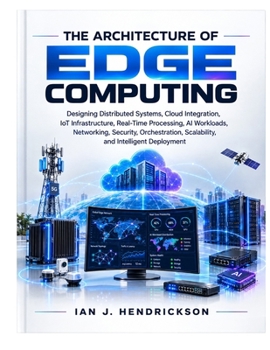
The Architecture of Edge Computing: Designing Distributed Systems, Cloud Integration, IoT Infrastructure, Real-Time Processing, AI Workloads, Networki

Ever wondered why the app on your phone responds instantly, while a factory sensor three states away has to think twice before it reacts? Or why some smart systems keep working flawlessly during a network outage, while others grind to a halt the moment the connection drops?
If you've ever asked yourself how modern machines, sensors, vehicles, and devices manage to process information in real time - often without ever touching a distant data center - this book was written to answer exactly that.
The Architecture of Edge Computing is a comprehensive, practically grounded guide to designing systems that think and act close to where data is actually created. Whether you're an engineer, architect, technical lead, or simply someone trying to understand how the next generation of connected infrastructure actually works, this book breaks down the entire discipline into clear, digestible, real-world logic - without drowning you in unnecessary jargon.
So what exactly will you walk away understanding?
You'll learn how distributed systems are designed to stay reliable even when networks fail. You'll understand how devices, gateways, and cloud platforms work together instead of against each other. You'll see how sensors, cameras, and industrial equipment communicate efficiently, even on limited power and bandwidth. You'll explore how artificial intelligence models are shrunk, optimized, and deployed directly onto small, resource-constrained hardware. And you'll walk through the security, orchestration, and deployment strategies that keep large-scale systems running smoothly across thousands of physical locations at once.
This book doesn't just explain concepts - it shows you how they connect. Each chapter builds on the one before it, using realistic case studies from manufacturing floors, retail chains, agricultural fields, hospitals, and smart city infrastructure to demonstrate exactly how these ideas play out in practice, not just in theory.
Inside, you'll discover:
How to design systems that keep functioning even when connectivity is unreliable or completely lostThe real trade-offs between processing data locally versus sending it to a centralized systemHow lightweight messaging protocols keep constrained devices talking efficientlyPractical approaches to compressing and deploying machine learning models on limited hardwareHow organizations secure thousands of physically exposed devices against real-world threatsThe deployment strategies that let teams safely update software across massive, distributed fleetsA practical framework for making sound architectural decisions, long after the latest technology trend has fadedYou don't need to be a distributed systems expert to get value from this book. If you're a student trying to understand where the industry is heading, a developer moving into infrastructure work, a technical manager overseeing connected devices, or simply someone curious about how the physical and digital worlds are increasingly working together in real time, this book meets you where you are and takes you further.
Technology changes fast. But the reasoning behind good architecture - knowing what to build, where to build it, and why - doesn't go out of date. This book was written to give you that reasoning, so you can apply it to whatever comes next.
If you're ready to understand how the next generation of connected systems is actually built, not just how it's marketed, this is where you start.
Customer Reviews
ThriftBooks ® and the ThriftBooks ® logo are registered trademarks of Thrift Books Global, LLC
