


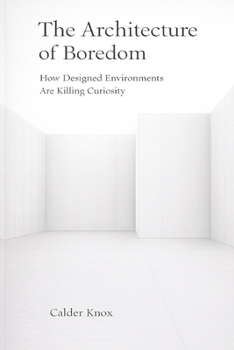
The Architecture of Boredom: How Designed Environments Are Killing Curiosity

Boredom is usually treated as a personal failure.
A lack of attention. A problem to fix.
This book approaches it differently.
The Architecture of Boredom examines how modern environments are designed to feel efficient, seamless, and safe and how those same qualities quietly drain curiosity from everyday life. Not through restriction, but through smoothness. Through systems that leave nothing unresolved and nothing to explore.
From architecture and urban planning to digital interfaces, workplaces, and public spaces, the book traces how environments shape inner experience before conscious thought begins. It shows how boredom emerges not from a lack of stimulation, but from an excess of predictability. When nothing resists us, curiosity has nowhere to go.
Written in an essayistic, observational style, this is not a guide or a diagnosis. It does not offer techniques, steps, or solutions. Instead, it lingers on what it feels like to move through spaces designed to eliminate uncertainty and what quietly happens to attention, desire, and meaning as a result.
This book is for readers interested in psychology, design, culture, and the subtle ways the built world shapes how we feel and think. It is for those who sense that something in modern life has gone flat, but have never quite had the language to name it.
Customer Reviews
ThriftBooks ® and the ThriftBooks ® logo are registered trademarks of Thrift Books Global, LLC
