


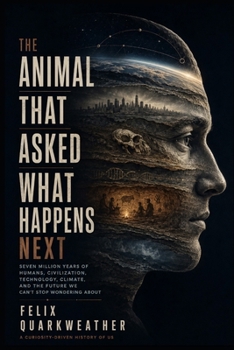
The Animal That Asked What Happens Next

What happens when you keep asking one simple question-What was it like before us?-and refuse to stop?
Go back a few hundred years and electricity disappears. Go back two thousand and Rome is building aqueducts, heated baths, and enormous cities. Go back ten thousand and agriculture itself is still an experiment. Go back fifty thousand and Homo sapiens shares the planet with other kinds of humans. Keep going, and eventually the face looking back at you no longer looks entirely human.
Then turn around.
Are we still evolving? Could technology change the human body itself? What might our descendants look like a million years from now? Will Earth keep getting hotter? Are we actually running out of water-and if some places have too little while others have too much, why can't we simply move it?
The Animal That Asked What Happens Next follows seven million years of human history and prehistory through the questions that make you stop and say, Wait. Seriously?
Felix Quarkweather travels from our earliest ape-like ancestors to Homo erectus, Neanderthals, Denisovans, the first Homo sapiens, agriculture, ancient cities, Rome, medieval Europe, the scientific revolution, industrialization, modern medicine, artificial intelligence, genetic engineering, climate change, desalination, water recycling, and possible human futures.
Along the way, the book separates what science actually knows from what researchers can reasonably infer-and from the enormous mysteries we may never solve.
Could two different human species have fallen in love?
What did the first conversations sound like?
Why did technological progress sometimes move backward?
Would someone from 100,000 years ago recognize us?
Could humanity eventually split into different species again?
And is modern civilization solving problems faster than it creates new ones?
Funny without treating the science like a joke and serious without reading like a textbook, The Animal That Asked What Happens Next is a curiosity-driven history of the strangest animal on Earth:
the one that learned enough about its past to become obsessed with its future.
Customer Reviews
ThriftBooks ® and the ThriftBooks ® logo are registered trademarks of Thrift Books Global, LLC
