


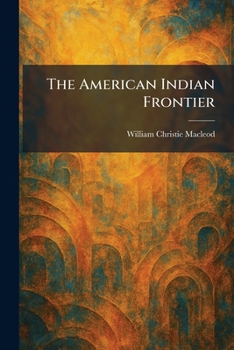
The American Indian Frontier

Select Format
Select Condition 
Book Overview
"The American Indian Frontier" offers an expansive and analytical look at the history of North America through the lens of the shifting boundaries between Indigenous civilizations and European expansionists. This work provides a detailed examination of the social, political, and economic forces that shaped the American frontier, moving beyond traditional narratives to explore the profound impact of colonization on Native American tribes. William Christie Macleod synthesizes a vast array of historical data to illustrate the complexities of cultural contact, conflict, and the eventual displacement of indigenous peoples.
The text delves into the varied experiences of different tribes, tracing the evolution of colonial policy and its consequences for land ownership and tribal sovereignty. By addressing the frontier as a zone of intense interaction, the book sheds light on the mechanisms of conquest and the resilience of Indigenous cultures in the face of rapid change. This scholarly study serves as a vital resource for readers interested in Native American history, the sociology of the frontier, and the foundational events that defined the early landscape of the United States. It remains a significant contribution to the understanding of the historical processes that transformed the continent.
This work has been selected by scholars as being culturally important, and is part of the knowledge base of civilization as we know it. This work was reproduced from the original artifact, and remains as true to the original work as possible. Therefore, you may see the original copyright references, library stamps (as most of these works have been housed in our most important libraries around the world), and other notations in the work.
This work is in the public domain in the United States of America, and possibly other nations. Within the United States, you may freely copy and distribute this work, as no entity (individual or corporate) has a copyright on the body of the work.
As a reproduction of a historical artifact, this work may contain missing or blurred pages, poor pictures, errant marks, etc. Scholars believe, and we concur, that this work is important enough to be preserved, reproduced, and made generally available to the public. We appreciate your support of the preservation process, and thank you for being an important part of keeping this knowledge alive and relevant.
Customer Reviews
ThriftBooks ® and the ThriftBooks ® logo are registered trademarks of Thrift Books Global, LLC
