


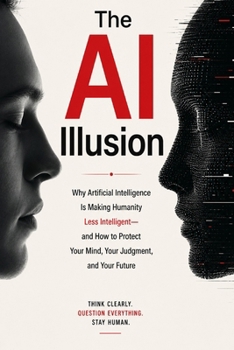
THE AI ILLUSION: Why Artificial Intelligence Is Making Humanity Less Intelligent—and How to Protect Your Mind, Your Judgment, and Your Future

What if the machines we trust to make us smarter are quietly making us think less?
Artificial intelligence promises faster decisions, greater efficiency, unbiased judgment, and a future where machines handle the complexity of human life.
But what happens when the machine is wrong?
The AI Illusion takes you behind the hype to expose the hidden weaknesses of modern artificial intelligence-and the dangerous human tendency to surrender judgment to algorithms.
From hiring systems that reproduce historical discrimination to predictive models that mistake the past for the future, from medical AI that can overwhelm professional judgment to content moderation systems that cannot understand context, this book reveals how seemingly intelligent systems can produce profoundly human failures.
The problem isn't simply that AI makes mistakes.
The deeper problem is that we increasingly trust those mistakes because they arrive wrapped in mathematics, data, dashboards, and the authority of a machine.
Drawing on real-world scenarios and practical frameworks, this book teaches you how to:
Recognize algorithmic bias hidden inside supposedly objective systemsUnderstand why predictive AI cannot truly see the futureDetect the difference between AI that is designed to sound right and AI designed to be rightIdentify automation bias before it erodes human expertiseQuestion black-box AI decisions instead of blindly accepting themExpose the hidden assumptions inside training dataDemand transparency, accountability, and human oversightProtect creativity and critical thinking in the age of generative AIDesign better human-AI workflows based on complementarity rather than replacementUse AI as a powerful assistant without surrendering your judgmentThe central argument is simple but radical:
The goal of AI should not be to eliminate the human element. It should be to amplify what makes humans irreplaceable.
Machines can process enormous amounts of information. Humans provide context.
Machines can recognize patterns. Humans understand meaning.
Machines can generate possibilities. Humans provide judgment, ethics, creativity, and purpose.
The future doesn't belong to people who blindly trust AI-or to people who reject it completely.
It belongs to people who know when to use the machine, when to question it, and when to trust their own judgment.
Think clearly. Question everything. Stay human.
Customer Reviews
ThriftBooks ® and the ThriftBooks ® logo are registered trademarks of Thrift Books Global, LLC
