


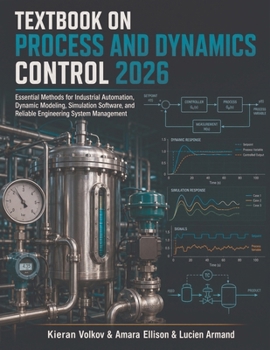
Textbook on Process and Dynamics Control 2026: Essential Methods for Industrial Automation, Dynamic Modeling, Simulation Software, and Reliable Engineering System Management

A valve can move immediately while the process takes minutes to reveal whether that move was right. That delay is where control engineering begins.
Industrial systems do not respond instantaneously or independently. Temperatures drift, levels accumulate, pressures interact, disturbances travel through equipment, and one control action can create an unexpected response somewhere else in the process.
Textbook on Process and Dynamics Control 2026 develops the engineering thinking needed to understand that behavior before attempting to control it.
Built for engineering students, automation learners, process professionals, and technical readers, the book connects dynamic behavior with modeling, simulation, feedback, and practical system management so that control decisions are based on how the process actually responds-not on trial and error.
Readers can develop a stronger working understanding of how to:
- Translate physical process behavior into useful mathematical representations
- Recognize first-order, higher-order, delayed, and interacting dynamic responses
- Examine feedback behavior and identify conditions that influence stability
- Approach controller adjustment with an understanding of the process behind the tuning decision
- Use simulation to investigate system behavior before changes are applied to real equipment
- Interpret disturbances, transient responses, and loop interactions more systematically
- Connect automation decisions with the reliability and performance of the larger engineering system
The value of a model is not simply that it produces a curve on a screen. Its value is that it helps an engineer anticipate what the real process is likely to do next.
That distinction becomes increasingly important when multiple variables interact, delays obscure cause and effect, or aggressive control creates more instability than it removes.
This textbook therefore approaches process control as a chain of engineering decisions: understand the dynamics, build a useful representation, test the response, and then decide how the system should be controlled.
Study the response before you tune the loop. Put Textbook on Process and Dynamics Control 2026 into your engineering library and learn to make the process predictable before asking the controller to correct it.
Customer Reviews
ThriftBooks ® and the ThriftBooks ® logo are registered trademarks of Thrift Books Global, LLC
