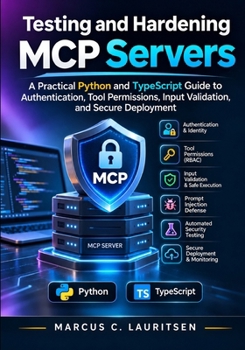
Testing and Hardening MCP Servers: A Practical Python and TypeScript Guide to Authentication, Tool Permissions, Input Validation, and Secure Deploymen

A working MCP server is not necessarily a secure one. What happens when an AI assistant calls a tool it should not use-or a request exposes information meant for someone else?
If securing AI integrations feels intimidating, Testing and Hardening MCP Servers offers a clear, step-by-step path from understanding the risks to putting practical safeguards in place. No previous MCP security experience is required. Basic familiarity with Python or TypeScript and APIs will help with the coding exercises, while straightforward explanations make each new concept manageable.
Work through a continuing example called OpsGuard MCP, a fictional internal operations server built with synthetic data. You will see how to introduce security controls one at a time, test whether they work, and learn from failed requests as well as successful ones. Each small improvement builds confidence without hiding the important engineering details.
Key FeaturesPractical, step-by-step examples: Learn with Python and TypeScript implementations using official MCP SDKs.
Realistic hands-on learning: Follow a continuous project that connects security principles to tool and resource operations.
Essential security protections: Explore authentication, access control, input validation, and prompt injection defense.
Testing and deployment guidance: Build automated security tests, CI/CD checks, and safer deployment configurations.
Practical reference materials: Reinforce your skills with security checklists, permission matrices, and troubleshooting guidance.
What You Will LearnUnderstand MCP architecture, client-server communication, transports, and security trust boundaries.
Implement OAuth authentication, verify access tokens, and enforce role-based permissions.
Protect sensitive records, validate tool inputs, and restrict unsafe operations.
Identify prompt injection threats and reduce risks from untrusted AI tool content.
Create automated security tests and regression checks to catch vulnerabilities.
Harden HTTP services and containers while protecting credentials and runtime permissions.
Monitor security events, investigate failures, and maintain dependable MCP integrations.
Who This Book Is ForThis book is designed for Python and TypeScript developers, backend engineers, AI application builders, and self-directed learners interested in secure AI integrations.
It is especially suitable for readers who are new to MCP security and want a supportive, structured introduction without unnecessary complexity. Basic programming and API knowledge are helpful, but prior experience securing MCP servers is not required.
Table of ContentsMCP Architecture and Security Foundations
Building MCP Servers with Python and TypeScript
Authentication and Identity Security
Tool Authorization and Permission Enforcement
Input Validation and Secure Tool Execution
Prompt Injection and MCP Integration Security
Automated Testing and Security Verification
Secure Deployment and Runtime Hardening
Monitoring, Auditing, and Maintaining MCP Security
Start Building More Secure MCP Servers TodayYou do not have to master everything on your first attempt. Every successful security check, corrected mistake, and properly rejected request brings you closer to becoming a more confident developer.
Take the next step in your MCP development journey. Get your copy today and learn to build, test, and protect AI integrations with greater confidence.
Customer Reviews
ThriftBooks ® and the ThriftBooks ® logo are registered trademarks of Thrift Books Global, LLC