


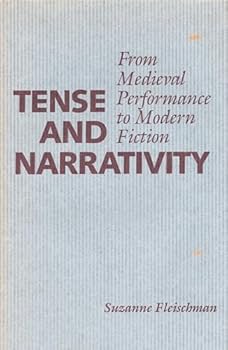
Tense and Narrativity: From Medieval Performance to Modern Fiction (Texas Linguistics Series)
No Customer Reviews

Select Format
Select Condition 
Book Overview
. . . Fleischman's book takes the study of medieval literature to new hermeneutic horizons. . . . Furthermore, through the use of sociolinguistics she connects the modern and medieval worlds in a way that will make the medieval world less alien to us, and thus her perspective gives us another means by which we can make medieval literature more relevant to our students. --Studies in the Age of Chaucer In this pathfinding study, Suzanne Fleischman brings together theory and methodology from various quarters to shed important new light on the linguistic structure of narrative, a primary and universal device for translating our experiences into language. Fleischman sees linguistics as laying the foundation for all narratological study, since it offers insight into how narratives are constructed in their most primary context: everyday speech. She uses a linguistic model designed for natural narrative to explicate the organizational structure of artificial narrative texts, primarily from the Middle Ages and the postmodern period, whose seemingly idiosyncratic use of tenses has long perplexed those who study them. Fleischman develops a functional theory of tense and aspect in narrative that accounts for the wide variety of functions--pragmatic as well as grammatical--that these two categories of grammar are called upon to perform in the linguistic economy of a narration.
Format:Hardcover
Language:English
ISBN:0292780907
ISBN13:9780292780903
Release Date:January 1990
Publisher:University of Texas Press
Length:459 Pages
Weight:1.75 lbs.
Dimensions:9.5" x 1.3" x 6.5"
Customer Reviews
0 rating
Copyright © 2026 Thriftbooks.com Terms of Use
| Privacy Policy | Do Not
Sell/Share My Personal Information | Cookie Policy | Cookie Preferences | Accessibility Statement
ThriftBooks® and the ThriftBooks® logo are registered trademarks of Thrift Books Global, LLC
ThriftBooks® and the ThriftBooks® logo are registered trademarks of Thrift Books Global, LLC
