
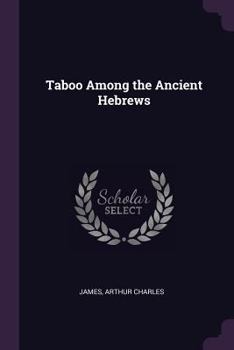
"Taboo Among the Ancient Hebrews" offers a detailed investigation into the religious and social prohibitions that governed the lives of the ancient Israelites. Arthur Charles James provides a systematic analysis of the concept of the "taboo"-the sacred or forbidden-and its foundational role in the development of early Hebrew society. The work explores various categories of taboo, including those related to holiness, uncleanness, dietary restrictions, and contact with the dead.
By comparing these practices with the customs of surrounding Semitic cultures, James illuminates the unique evolution of Israelite law and ritual. The study examines how these ancestral taboos functioned as mechanisms for maintaining communal identity and spiritual purity. This work remains a significant contribution to the fields of biblical anthropology and the history of religion, providing readers with insights into the primitive roots of many traditions that would eventually be codified in the Hebrew Bible. It is an essential resource for those interested in the sociological underpinnings of ancient religious life and the historical development of sacred law.
This work has been selected by scholars as being culturally important, and is part of the knowledge base of civilization as we know it. This work was reproduced from the original artifact, and remains as true to the original work as possible. Therefore, you may see the original copyright references, library stamps (as most of these works have been housed in our most important libraries around the world), and other notations in the work.
This work is in the public domain in the United States of America, and possibly other nations. Within the United States, you may freely copy and distribute this work, as no entity (individual or corporate) has a copyright on the body of the work.
As a reproduction of a historical artifact, this work may contain missing or blurred pages, poor pictures, errant marks, etc. Scholars believe, and we concur, that this work is important enough to be preserved, reproduced, and made generally available to the public. We appreciate your support of the preservation process, and thank you for being an important part of keeping this knowledge alive and relevant.

