


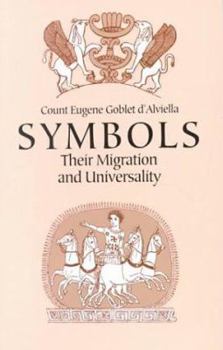
Symbols: Their Migration and Universality (Dover Occult)

This remarkable classic by a world expert on the evolution and migration of symbols explains in detail what a symbol is, how it served a culture, developed or fell into disuse. Considerable attention... This description may be from another edition of this product.
Format:Paperback
Language:English
ISBN:048641437X
ISBN13:9780486414379
Release Date:July 2000
Publisher:Dover Publications
Length:320 Pages
Weight:0.80 lbs.
Dimensions:8.5" x 0.8" x 5.5"
Customer Reviews
1 rating
The Migration and Universality of Symbols.
Published by Thriftbooks.com User , 17 years ago
_Symbols: Their Migration and Universality_ is a Dover edition of the work _The Migration of Symbols_ first published in 1894 by Count Eugene Goblet d'Alviella which features a unique study and interpretation of symbols from around the world and their migrations and universality amongst all cultures. Count Goblet d'Alviella (1846 - 1925) was a lawyer and senator in Belgium as well as a noted freemason and professor of religions. This work on symbols is an important work in the development of archaeology and offers a unique interpretation of the symbols of man. This book features an introduction by Sir George Birdwood which speaks to this work by Count Goblet d'Alviella. The book mentions a wide variety of symbols from ancient cultures and notes their migrations across the globe from their ancient sources. The book also includes a wide variety of detailed drawings showing the ancient symbols and artifacts. In the Introduction, Sir George Birdwood examines the symbols mentioned by the author as they relate to ancient cultures. Such symbols as the tricula or Vardhamana of the Buddhists are mentioned as well as the gammadion or swastika. These symbols as they relate to ancient religions and cultures are discussed including reference made to the ancient Hindus and ancient Egypt, Phoenicia, Mesopotamia, Syria, and Greece (as well as ancient Europe). Birdwood mentions the "Feet of Buddha", the triskelion, and the gammadion or "fylfot-cross" identified with the swastika of the Hindus. Birdwood also mentions the doubleheaded eagle born on the arms of the rulers of Austria and Russia as well as the "Tree of Life". Important works cited by Birdwood include the work _The Industrial Arts of India_. This book by Count d'Alviella begins with a preface that attempts to define the word "symbol". The author notes the original meaning of this term amongst the Greeks and discusses how it came to be applied to anything that represents something. The author defines a symbol as "a representation which does not aim at being a reproduction". The author mentions the theories of Herbert Spencer, Professor Sabatier, Creuzer, Max Muller, and several others concerning the nature of myth and discusses the nature of God and the "unknown and unknowable Reality", mentioning also ancient mystery cults (the Eleusinian mysteries) and Christianity. In the first chapter of this book, the author discusses "On Symbols Common to Different Races". The author mentions the identity of certain symbols in the symbolism of certain races and "spontaneous coincidences" among the appearance of ancient symbols. The author mentions such things as the Cross of ancient Christianity, St. Anthony's Cross, the triscele, the Doubleheaded Eagle, the Hand of Providence, and the Lotus Flower. The author also notes the manner in which symbols are transmitted from nation to nation and the principle causes of their diffusion. The second chapter of this book discusses "On the Gammadion or S
Copyright © 2026 Thriftbooks.com Terms of Use
| Privacy Policy | Do Not
Sell/Share My Personal Information | Cookie Policy | Cookie Preferences | Accessibility Statement
ThriftBooks® and the ThriftBooks® logo are registered trademarks of Thrift Books Global, LLC
ThriftBooks® and the ThriftBooks® logo are registered trademarks of Thrift Books Global, LLC
