


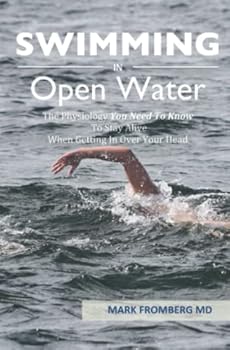
SWIMMING IN OPEN WATER: The Physiology You Need To Know To Stay Alive When Getting In Over Your Head
No Customer Reviews

A Book That May Save Your Life After the author learned to swim as an adult, he was struck by what extra skills he still had to learn with swimming in open water. And after competing in his first triathlons, he had heard about several athletes dying in the swim portion of triathlons, and became obsessed with trying to understand why these tragedies were happening so frequently, especially at the beginning of a race, well before exhaustion, dehydration, and overheating should be factors. With his medical training, and his experience providing medical support to various open water swims and triathlons (including 10 Ironman races), he has been able to tease out why most of these deaths have happened. This book is the second in the Swimming In Open Water series (learn more at openwaterswimbook.com). It provides the critical physiology at play in most open water swims, reducing some complex medical concepts into understandable language. The book is intended to help open water swimmers and triathletes stay alive in the open water, and to help reduce risks for swimmers and race directors alike. There is no book like it. What You Will Learn: Part 1 summarizes the many triggers that are potential physiological stressors when swimming in open water. To become a master of your open water milieu, it is important to first realize that the human body is affected by many variables commonly present in open water, each being a stressor that can potentially elicit a physiological reaction.Part 2 outlines 18 known physiological reactions, and is the core of this book. Most of these reactions can be life-threatening due to their profound effect on lung, heart, brain and/or limb function; some can develop dramatically and quickly, while others may have a more delayed effect. This section lists and describes the presumed and studied mechanisms behind these potentially adverse, physiological responses. After each of these descriptions, solutions are provided--the best recommendations and preventive strategies to minimize or eliminate each of them. Part 3 provides a summary of the "Solutions" sections of Part 2 for easy reference, and in an appropriate checklist-like sequence. Where appropriate, there are added drills and exercises appropriate to reducing these physiological risks. To maximize open water swimming enjoyment, the goal for all participants is to be proactive, knowledgeable and prepared at all times: to accept some risks, but to responsibly manage them; to acknowledge fears, but to challenge them with a reasoned approach and alternative perspectives; to grow your knowledge base, by learning from every swimming and exercise experience (yours and others'); and to become fluent in your unique physiology and personal health, as you develop a disciplined, preventive mindset, whether young or old. Part 4 provides an extensive list of links to useful references, both in the lay press and as academic articles, many of which are easily accessed online. Mastery Of The Open Water Milieu By the time you complete this read, you should have a clear idea of how to mitigate your risks when getting in over your head, whether you are training or racing in open water. Even better, your confidence in open water may have grown enough to take on bigger events, or to consider coaching other newcomers to open water swimming. Order now while at the introductory price! This may be the most important book on open water swimming you will ever read.
Format:Paperback
Language:English
ISBN:1982962984
ISBN13:9781982962982
Release Date:May 2018
Publisher:Independently published
Length:206 Pages
Weight:0.66 lbs.
Dimensions:8.0" x 0.5" x 5.3"
Customer Reviews
0 rating
Copyright © 2026 Thriftbooks.com Terms of Use
| Privacy Policy | Do Not
Sell/Share My Personal Information | Cookie Policy | Cookie Preferences | Accessibility Statement
ThriftBooks® and the ThriftBooks® logo are registered trademarks of Thrift Books Global, LLC
ThriftBooks® and the ThriftBooks® logo are registered trademarks of Thrift Books Global, LLC
