


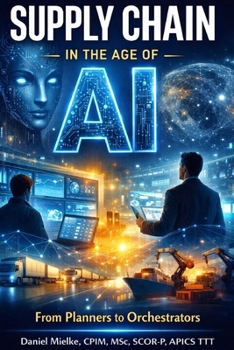
Supply Chain in the age of AI

Supply Chain in the Age of AI is a practical, executive-level guide to redesigning supply chains for a world where volatility is constant, decisions must be faster, and data is abundant-but rarely aligned.
This book cuts through the hype around Artificial Intelligence and focuses on what actually drives performance: better decisions, made systematically, across the enterprise.
What you'll learn:
Why most supply chains underperform
Not because of tools-but because of fragmented decision-making, weak governance, and misaligned incentives.
How AI really creates value in supply chain
From demand sensing and inventory optimisation to predictive risk management and autonomous planning-explained in clear business terms, not technical jargon.
How to move from S&OP to true IBP (Integrated Business Planning)
Positioning supply chain as a financial control system, aligning demand, supply, and finance into one coherent decision engine.
How to design a resilient, adaptive network
Using segmentation, dual sourcing, and scenario planning to manage risk while protecting margin and service.
How to lead transformation at scale
Embedding governance, decision rights, and performance metrics that drive real behavioural change-not just system implementation.
What makes this book different:
This is not a technology book. It's a decision-making and leadership playbook.
Drawing on real-world experience across complex, multi-site manufacturing environments, the book introduces a powerful idea:
AI does not fix broken supply chains. It amplifies them.
If your processes, data, and governance are weak, AI will accelerate the chaos.
If they are strong, AI becomes a true competitive advantage.
Who this book is for:
Supply Chain Directors, COOs, and Operations Leaders.
Finance and Commercial leaders working cross-functionally.
Transformation leaders driving S&OP / IBP / digital programmes.
Anyone looking to move from operational firefighting to enterprise-level control.
The outcome:
By the end of this book, you will know how to:
Turn supply chain into a strategic driver of revenue, margin, and cash.
Build a connected decision-making system, not a collection of functions.
Use AI as an enabler of control, not a substitute for it.
Lead with clarity in an increasingly complex and uncertain world.
This is your blueprint to move from silos to synchronisation-powered by AI, governed by decisions, and anchored in financial outcomes.
Customer Reviews
ThriftBooks ® and the ThriftBooks ® logo are registered trademarks of Thrift Books Global, LLC
