


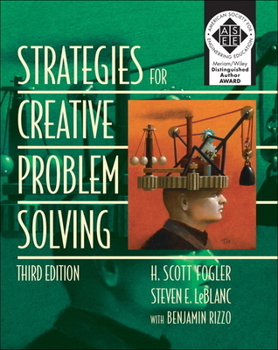
Strategies for Creative Problem Solving

Select Format
Select Condition 
Book Overview
A Tested, Proven Approach to Problem Solving--Updated with New Material and Current, Real-Life Examples Strategies for Creative Problem Solving, Third Edition, will help you hone your creative skills and apply those skills to solve nearly any problem. Drawing on National Science Foundation-funded, advanced research that studied problem-solving techniques in all areas of modern industry, this book presents a comprehensive, systematic problem-solving framework. Through hands-on techniques and exercises drawing on realistic examples, you will learn how to approach an ill-defined problem, identify the real problem, generate and implement the best solution, evaluate what you've learned, and build on that knowledge. This third edition has been updated and revised, further enhancing its value for engineers, technical practitioners, students, and anyone who wants to improve their problem-solving skills. Updates include More than twenty-five new examples--based on recent, real-world events and topics--that illustrate the various problem-solving techniques Expanded coverage of critical thinking and reasoning An introduction to structured critical reasoning New discussion of managing complex change Expanded and improved explanations of the components of problem-solving strategies The first edition of this book earned ASEE's 1996 Meriam-Wiley Distinguished Author Award, and now it's more focused and useful than ever. Companion Web Site The book's companion Web site (www.engin.umich.edu/scps) is a valuable resource for students and instructors. The site contains Interactive Computer Modules: Seven simulations linked to the book's content and designed to deepen your expertise with every stage of the problem-solving process Summary Notes: Chapter-specific material that highlights important points in each chapter--excellent for classroom presentations and concept review Professional Reference Shelf: Additional examples and problem-solving materials Additional Study Materials: Course syllabi and Web links to related material
Format:Paperback
Language:English
ISBN:013309166X
ISBN13:9780133091663
Release Date:October 2013
Publisher:Pearson
Length:384 Pages
Weight:1.77 lbs.
Dimensions:1.0" x 7.9" x 9.9"
Related Subjects
Behavioral Sciences Business Business & Finance Business & Investing Cognitive Cognitive Psychology Creativity & Genius Decision-Making & Problem Solving Economics Education Education & Reference Engineering Health, Fitness & Dieting Health, Fitness & Dieting Industrial, Manufacturing & Operational Systems Instruction Methods Management & Leadership Pedagogy Psychology Psychology & Counseling Schools & Teaching Science & Math Self Help Self-Help Self-Help & Psychology Skills Social Sciences Technology TextbooksCustomer Reviews
5 ratings
textbook
Published by Thriftbooks.com User , 17 years ago
I have enjoyed this book as it is a refresher for me in process improvement models. It is an easy book to read and understand.
Good book
Published by Thriftbooks.com User , 20 years ago
I used either this book or a similar one for my freshman engineering class. The reading and technical difficulty was appropriate for me in that class. Having worked at TRW, a little at GM, and now at Intel, I believe the concepts taught in this book are quite useful, and are practiced often by engineers at "engineering" companies. The problem is this book is usually read by students in their 1st year, then for the following 2 - 3 years of undergraduate schooling, students essentially sit in lecture classes learning concepts of science and technology. Come senior year, students are then expected to implement the lessons from this book as part of doing their capstone project, as if they even remember this book. Written by two engineering professors as a book for beginning engineering students, the problem solving concepts contained in this book are appropriate for anyone working in any field; not just engineering. The problem is it does not introduce students to the reality of life as a working engineer and does not help students choose which field of engineering they like to join. The question begs then as to what is the reality of life as an engineer... Excluding engineering professors, here is what I picture as the realities of being an engineer: 1) Technology constantly changes. Part of being an engineer is always deciding which changes to adopt and which to ignore. For example, at my biweekly group meeting in Intel, our manager shows us new automation software that we as a group must decide whether or not we want to adopt. We don't write these software, but we have to decide whether or not we want to use them. 2) Our skills are not needed. Doctors will always be needed, because people always get sick or hurt. Teachers will always be needed, because people always need to be taught stuff. But as engineers, many of the services and expertise we offer society can be done without. If the price of gasoline keeps going up, a lot of engineers who specialize on combustion engines are going to find themselves obsolete. Likewise, the rank of analog engineers working at Motorola have dwindled over the past decade. Therefore, part of being an engineer is having to constantly learn new skills. 3) We are very replaceable. For example, a family physician obtains and sustains his business by spending quality time with each and every of her patients. Very few people, once they find a family physician they like, will switch to another one. The same concept applies to dentists, car mechanics, hairdressers, tailors, vets, babysitters, home repairmen, insurance agents, etc... But engineers by and large work on producing a physical item; i.e. a computer, a car, a knee implant, a radio, etc... Outside of bridges, airplanes, power plants, etc... the final purchaser of our product will never come into contact with any of the engineers who helped designed or produced it. Therefore, price becomes more important in the purchasing of engine
Lecturer and Engineer
Published by Thriftbooks.com User , 22 years ago
I would highly recommend any engineering student to read this book. It is worthy to buy and keep it on your library. This will be one of many most useful books you have ever considered in your engineering career.
Fantastic Book: Not For Cry Babies
Published by Thriftbooks.com User , 23 years ago
This is mainly a to stress that problems can be solved with an open minded approach such as the authors recommend. Unlike the cry baby whose essentially useless review shows that he has not and never will solve any real world problems. Probably a disgruntled ex student who got a D-.
Well organized, and entertaining intro to problem solving
Published by Thriftbooks.com User , 27 years ago
This is a systematic and well organized introduction. I used it with managers and students not just engineers. What was important was not just to follow an algorithmic approach but to imbue a way of thinking. It simply is not true that everyone has formed the discipline to use their mind following these or similar heuristics. We may stumble on them naturally, I agree. But for many people this is a useful revelation. In addition to the book, they have produced software to engage you in learning the problem strategies. Compared to many other books on the subject, this book has enough real world examples and strategies that it is not just pop psychology or wishful thinking or one more brainstrom with web-like diagrams.
Copyright © 2026 Thriftbooks.com
Terms of Use | Privacy Policy | Do Not Sell/Share My Personal Information | Cookie Policy | Cookie Preferences | Accessibility Statement
ThriftBooks ® and the ThriftBooks ® logo are registered trademarks of Thrift Books Global, LLC
ThriftBooks ® and the ThriftBooks ® logo are registered trademarks of Thrift Books Global, LLC
