


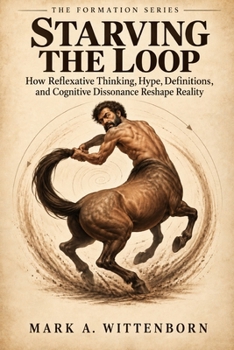
Starving the Loop: How Reflexative Thinking, Hype, Definitions, and Cognitive Dissonance Reshape Reality

What happens when an idea no longer simply describes reality, but begins reshaping it?
A grain of truth becomes hype. Hype changes behavior. Behavior changes reality. Then the changed reality is used to prove the hype.
The loop closes.
STARVING THE LOOP examines how repetition, reinforcement, changing definitions, social pressure, and cognitive dissonance can train people to defend conclusions they never fully examined. Mark A. Wittenborn describes this kind of response as Reflexative thinking: a response formed through repetition, justification, or cultural conditioning until it begins answering before truth is freshly considered.
This is not a clinical diagnosis, and it is not another attempt to prove that everyone on the other side has been deceived. The examination must begin with us. A system that cannot be wrong cannot become more right.
These loops appear in politics, media, institutions, churches, families, personal relationships, and even in the stories we tell ourselves. They can turn a partial truth into an unquestionable narrative, an inherited grievance into an obligation, or a familiar definition into something that quietly changes beneath our feet.
The problem is that direct confrontation does not always break the loop. Sometimes the argument itself becomes fuel. Every objection is treated as proof. Every contradiction is explained away. Every challenge strengthens the belief it was meant to test.
That is when the loop must be starved.
Through practical examples, personal experience, historical patterns, biblical principles, and pointed questions, STARVING THE LOOP shows how to slow the reaction, examine the foundation, test definitions, separate evidence from repetition, and return to the fork where our thinking first went wrong.
Turning around is not always easy. It may require admitting that we defended something before we understood it, inherited a conclusion we never earned, or continued building on a foundation that could no longer carry the weight.
Written from a Christian formation perspective, this book is not merely about learning better arguments. It is about becoming the kind of person who can still be corrected by truth.
Because sometimes the way out is not to argue harder.
Sometimes you have to starve the loop.
Related Subjects
Political Science Politics & Social Sciences Self Help Self-Help Self-Help & PsychologyCustomer Reviews
ThriftBooks ® and the ThriftBooks ® logo are registered trademarks of Thrift Books Global, LLC
