


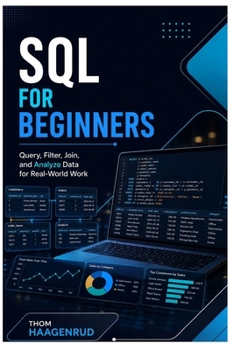
SQL for Beginners: Query, Filter, Join, and Analyze Data for Real-World Work

Do you want to work confidently with business data but feel overwhelmed by databases, unfamiliar commands, or complicated technical explanations?
SQL for Beginners is a practical, step-by-step guide to retrieving, organizing, cleaning, and analyzing structured data. Written for complete beginners, it teaches you how to turn everyday questions into clear SQL queries that produce useful and reliable answers.
SQL is used far beyond software development. Analysts, accountants, auditors, researchers, operations teams, students, administrators, and business professionals use it to investigate records, prepare reports, check figures, find missing information, and support better decisions.
This book begins with the foundations of relational databases before gradually moving into practical reporting and analysis. You will learn how tables connect, what rows and columns represent, how keys create relationships, and how to build queries without losing control of your results.
Inside this practical guide, you will learn how to:
- Understand databases, tables, rows, columns, and relationships
- Recognize primary keys and foreign keys
- Write clear SELECT statements
- Retrieve only the columns needed for a task
- Filter records using WHERE, BETWEEN, IN, and LIKE
- Combine conditions safely with AND, OR, and NOT
- Sort results and identify top or bottom records
- Remove unnecessary duplicate results with DISTINCT
- Work with text, numbers, dates, and null values
- Calculate totals, averages, counts, minimums, and maximums
- Create useful summaries with GROUP BY and HAVING
- Combine related tables with INNER, LEFT, RIGHT, and FULL OUTER joins
- Avoid duplicate rows and inaccurate totals after joining tables
- Build layered queries with subqueries and common table expressions
- Clean inconsistent values and create categories with CASE
- Prepare datasets for reports, dashboards, and business analysis
- Test filters, joins, aggregates, and row counts
- Diagnose errors and improve unreliable queries
- Complete practical projects using customers, orders, products, and payments
The examples are built around realistic workplace questions. You will analyze customer activity, prepare monthly sales summaries, compare regions and products, identify missing records, review inventory, create dashboard-ready datasets, and perform data-quality checks.
The final project section helps you build a beginner portfolio through a customer order report, sales-performance dataset, product inventory review, customer-segmentation query set, and data-quality audit.
No previous database or programming experience is required. The lessons use widely recognizable SQL patterns that provide a strong foundation for working with PostgreSQL, MySQL, SQL Server, SQLite, Oracle, cloud data platforms, and other relational systems.
Whether you are moving beyond spreadsheets, preparing for an analyst role, supporting business reports, studying databases, or adding a valuable technical skill to your career, this book gives you a clear path forward.
Stop relying on copied commands you do not fully understand. Learn how to write readable queries, verify your results, and turn structured records into meaningful information.
Customer Reviews
ThriftBooks ® and the ThriftBooks ® logo are registered trademarks of Thrift Books Global, LLC
