


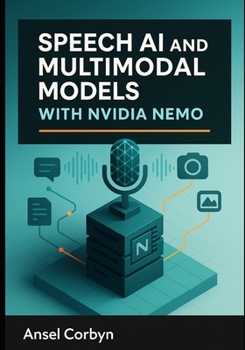
Speech AI and Multimodal Models with Nvidia Nemo: Build automatic speech recognition, text-to speech, and vision-language systems with production-grad
No Customer Reviews

Build dependable speech and multimodal systems from data to deployment with NeMo, Riva, Triton, and NIM.
Shipping ASR, TTS, and vision language features is hard because real traffic, latency budgets, and safety rules punish vague guidance. Teams need a concrete stack, tested workflows, and playbooks that hold up under load.
This book gives practitioners a practical path. Train with NeMo, serve with Triton and Riva, package stable APIs with NIM, and wire observability, safety, and rollout controls so your services stay reliable after launch.
Map the NVIDIA stack in production, NeMo for training, Riva for runtime, NIM for standard APIs, Triton for serving and metricsSet up containers, GPU drivers, CUDA, and validation checks for a clean starting environmentBuild NeMo manifests, create tarred WebDataset shards, and manage data versions for repeatable trainingApply text processing that works in products, PnC models for punctuation and case, grammar based ITN with SparrowhawkChoose and justify architectures, CTC and RNNT tradeoffs, FastConformer for short and long speech, Parakeet for multilingual, Canary for translation and timestampsDesign streaming with intent, lookahead, chunk size, and padding choices that balance latency and accuracyRun NeMo 2 configs and NeMo Run cleanly, migrate experiments, track ablations, and keep results comparableEvaluate with WER, CER, MER, and slice by accent, SNR, and channel so quality numbers reflect realityAdd diarization that operators can trust, VAD with MarbleNet, embeddings with TitaNet, and MSDD integrationExport for serving the right way, ONNX or TorchScript paths, TensorRT where appropriate, and Triton model repos that scaleTune Riva streaming ASR, chunk and padding settings, punctuation and ITN options, diarization flags and limitsStand up NIM ASR endpoints with an OpenAI compatible surface and autoscale them with Helm on KubernetesBuild TTS that sounds right and runs fast, FastPitch with HiFi GAN or BigVGAN, voice cloning data, lexicons, SSML controlsManage prosody and latency for streaming audio, set clause sizes and playback buffers that feel responsiveProtect your product, content safeguards in TTS, consent gates for data and cloning, redaction and retention policiesMeasure what matters, Triton metrics in Prometheus and Grafana, practical alert rules that catch real issuesLoad test with perf analyzer sweeps, batch and concurrency tuning, sequence batching for conversational trafficEngineer reliability, fault injection and backpressure, graceful degradation under spikes and partial failuresWire NeMo Guardrails around ASR, TTS, and VLM flows so outputs stay on policyWatermark and detect audio with AudioSeal and formalize a detection pipelineUnderstand licenses and terms, NVIDIA AI Enterprise scope, Riva EULA, and NGC usage expectationsUse production playbooks with SLOs, cost caps, and rollback guards that turn operations into repeatable stepsThis is a code heavy guide with working Python, YAML, JSON, and Shell examples that you can adapt directly into real services.
Get the guide and build systems your users can rely on.
Format:Paperback
Language:English
ISBN:B0FZS46RJR
ISBN13:9798273025103
Release Date:November 2025
Publisher:Independently Published
Length:308 Pages
Weight:1.18 lbs.
Dimensions:0.7" x 7.0" x 10.0"
Customer Reviews
0 rating
Copyright © 2026 Thriftbooks.com
Terms of Use | Privacy Policy | Do Not Sell/Share My Personal Information | Cookie Policy | Cookie Preferences | Accessibility Statement
ThriftBooks ® and the ThriftBooks ® logo are registered trademarks of Thrift Books Global, LLC
ThriftBooks ® and the ThriftBooks ® logo are registered trademarks of Thrift Books Global, LLC
