


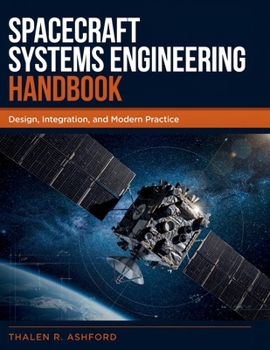
Spacecraft Systems Engineering Handbook: Design, Integration, and Modern Practice

The engineering knowledge required to design a spacecraft is spread across dozens of specialist textbooks, standards documents, and conference proceedings - each excellent within its discipline, none connecting the whole.
This handbook closes that gap.
Twenty chapters develop every major spacecraft subsystem at working-engineer depth - governing equations derived, not just stated; numerical examples carried to computed results; and cross-references that trace every output to the inputs it feeds in every adjacent chapter. A single spacecraft - a 1,500 kg Earth observation satellite in Sun-synchronous orbit at 500 km - runs as the worked example throughout, so every formula lands on real numbers and every result is traceable across the full design.
Coverage includes:
Space environment: radiation dose, plasma charging, atomic oxygen flux, thermal cycling, and debris risk - and how each constrains every subsystem that followsOrbital mechanics and mission analysis: vis-viva equation, eclipse fraction, nodal regression, constellation designChemical and electric propulsion sizing: specific impulse trades, propellant mass computation, and the power-transfer time tradeoff for all-electric platformsElectrical power systems: solar array sizing and degradation, battery management, power conditioning architecture, eclipse and sunlit mode budgetsAttitude determination and control: disturbance torque analysis, sensor and actuator selection, linearised control lawsStructures: launch load cases, natural frequency requirements, material selection, ECSS-compliant design marginsThermal control: coating selection, MLI sizing, radiator area, heater allocation, eclipse-sunlit cyclingTelecommunications: link budget development, Friis transmission equation, noise temperature, uplink and downlink marginTelemetry, command, and on-board data handling; EMC and ECSS-compliant verification; AIV test sequencing and model philosophySmall satellite and CubeSat systems engineering at genuine design depth - subsystem selection under real mass, power, and volume constraintsModel-based systems engineering: SysML architecture modelling, interface control, requirement traceability, digital twin integrationBoth heritage-qualified and commercial new space practice - reusable launch vehicles, rideshare, mega-constellation operations, software-defined ground infrastructure - are addressed throughout. ECSS and CCSDS standards provide the governing framework where they apply.
For engineers entering spacecraft programmes or transitioning into systems roles; graduate students seeking a comprehensive systems-level reference; and practitioners who need one structured resource that connects every discipline and every decision.
Related Subjects
Engineering Science Science & Math Science & Scientists Science & Technology TechnologyCustomer Reviews
ThriftBooks ® and the ThriftBooks ® logo are registered trademarks of Thrift Books Global, LLC
