


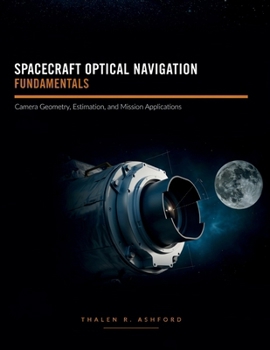
Spacecraft Optical Navigation Fundamentals: Camera Geometry, Estimation, and Mission Applications

A spacecraft navigating the deep solar system has no GPS. It has a camera, a star catalog, and the mathematics to turn photons into position. This book teaches that mathematics - completely, rigorously, and from first principles.
Spacecraft Optical Navigation Fundamentals takes the reader from the geometry of a single pixel to the design of a complete autonomous navigation system. Every equation is derived. Every variable is defined with units. Every method states exactly where it applies - and where it does not.
The book covers the full pipeline: camera geometry and projective models, reference frames and astrometry, scene radiometry and sensor physics, star tracker attitude determination, horizon-based and triangulation methods, the navigation filter, terrain relative navigation, small body proximity operations, angles-only formation flying, and autonomous system design. Sixteen chapters. One consistent mathematical framework. No gaps.
Worked derivations connect theory to implementation at every step. The reader who finishes this book can read mission documentation, implement algorithms, and make the engineering trade-offs that real programs require.
Written for: graduate students in aerospace engineering; GNC engineers entering optical navigation; practitioners who need the derivations, not just the results.
Prerequisite: linear algebra, probability, and introductory orbital mechanics.
Related Subjects
Engineering Science Science & Math Science & Scientists Science & Technology TechnologyCustomer Reviews
ThriftBooks ® and the ThriftBooks ® logo are registered trademarks of Thrift Books Global, LLC
