


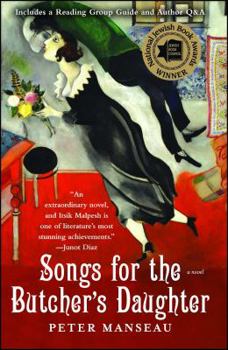
Songs for the Butcher's Daughter

Select Format
Select Condition 
Book Overview
An inventive literary debut, Songs for the Butcher's Daughter is a sweeping Yiddish-inflected immigrant saga and love story about a young translator, an aging poet, and the faith in words that survives even the death of a language. Summer, sweltering, 1996. A book warehouse in western Massachusetts. A man at the beginning of his adult life--and the end of his career rope--becomes involved with a woman, a language, and a great lie that will define his future. Most auspiciously of all, he runs across Itsik Malpesh, a ninetysomething Russian immigrant who claims to be the last Yiddish poet in America. When a set of accounting ledgers in which Malpesh has written his memoirs surfaces--twenty-two volumes brimming with adventure, drama, deception, passion, and wit--the young man is compelled to translate them, telling Malpesh's story as his own life unfolds, and bringing together two paths that coincide in shocking and unexpected ways. Moving from revolutionary Russia to New York's Depression-era Lower East Side to millennium's-end Baltimore with drama, adventure, and boisterous, feisty charm to spare, the unpeeling of this friendship is a story of the entire twentieth century. For fans of Nicole Krauss, Nathan Englander, Richard Powers, Amy Bloom, and Lore Segal, this book will amaze at every turn: narrated by two poets (one who doesn't know he is and one who doesn't know he isn't), it is a wise and warm look at the constant surprises and ineluctable ravages of time. It's a book about religion, love, translation, and typesetting--how one passion can be used to goad and thwart the other--and most of all, about how faith in the power of words can survive even the death of a language. A novel of faith lost and hope found in translation, Songs for the Butcher's Daughter is at once an immigrant literary saga, a love story for the ages, a Yiddish-inflected laughing-through-tears tour of world history for Jews and Gentiles alike, and a testament to Manseau's ambitious genius.
Format:Paperback
Language:English
ISBN:1416538712
ISBN13:9781416538714
Release Date:June 2009
Publisher:Free Press
Length:400 Pages
Weight:0.87 lbs.
Dimensions:1.0" x 5.6" x 8.4"
Customer Reviews
3 ratings
How did a Catholic boy write this?
Published by Thriftbooks.com User , 17 years ago
I am a secular Jew. Like myself, this novel is far more ethnic than religious. It's incredibly Jewish, but at the same time wonderfully inclusive. What I mean is, you do NOT have to be Jewish to read and enjoy this novel. In fact, it is a tale literally being told by an outsider. Songs for the Butcher's Daughter is a story within a story. On the surface, it is the fictionalized autobiography of Itsik Malpesh, "the last Yiddish poet in America." Born in 1903 in the middle of a Russian pogrom, Malpesh leads a picaresque life that takes him from the town of his birth to Odessa, from Odessa to New York, and eventually to Baltimore, Maryland. It's a long, eventful, tragic, dramatic, funny, and occasionally joyful life. In the course of its telling, Malpesh documents anti-Semitism in the old world, the birth of Israel, the death of Yiddish, the American immigrant experience, and a saga of star-crossed love. But it's so much more. Itsik's is such a human story! It's beautiful and compelling and grabbed me right from the opening pages. The story within this story comes in the form of copious "translator's notes." Itsik's memoir was written in his native tongue, Yiddish. His story is being filtered through an unlikely translator, a young, non-Jewish, college grad with an all-but-useless theology degree. The most marketable of his skills is his knowledge of the Hebrew alphabet. It's enough to get him a job in a warehouse of Yiddish literature run by a Jewish organization. Bored beyond belief, this nameless narrator teaches himself the language and embarks on his own journey which eventually leads to nonagenarian Itsik Malpesh. Amazingly, Itsik's story and the narrator's story have strange little connections that reminded me of the subtle connections between the stories in David Mitchell's Cloud Atlas. However, these coincidental connections shouldn't have surprised, as the past never really seemed to stay the past in Itsik's long life. People came and went and reappeared when and where you least expected them. Or perhaps where you most expected them. Call backs and foreshadowing were used to good effect, and overall the writing of this debut was impressive. The story started to drag just a bit late in the novel, but the ending was so satisfying that it hardly seems worth mentioning. This is a truly auspicious debut, and I will be waiting with considerable interest to see what Peter Manseau writes next.
Its All in the Translation
Published by Thriftbooks.com User , 17 years ago
There are as many ways to understand and appreciate this book as there are readers because we hear other people's stories in the language and context that we have grown up with. At one point Itsik says "How is it that we are to others what we are not to yourselves? Does a word know its own meaning? Does a letter know the sound that it signifies? How then can we pretend to know what our lives are for?" We shape and are shaped by the people and events of life, each of us simultaneously the translator and the translated, the story of who we are always in draft form. Peter Manseau also reminds us that it is a mistake to confuse facts with truth. "Songs for the Butcher's Daughter" would be a good choice for a book club and will play in your mind long after the final page.
beautiful and moving
Published by Thriftbooks.com User , 17 years ago
I fell in love with "Songs for the Butcher's daughter" from the very beginning. This book turned out to contain everything I wish for in a good novel: love of books, the intellectual pursuit, a love story, a picaresque memoir, all written in a great, rich prose by the author who obviously has a lot of background knowledge about the subject he chose. The narrator, a Catholic young man from Boston, who has just graduated from college (author's alter ego), finds himself in desperate need of a job. He finds employment, thanks to his knowledge of Hebrew, in the warehouse of the Jewish Cultural Organization, sorting thousands of books donated to charity. As soon as he begins, he realizes that the books are not in Hebrew at all, but in Yiddish... He is intrigued and quickly learns the language - and then becomes a translator of the memoirs written by the nonagenarian Itsik Malpesh, a Russian Jew born in 1903 in Kishinev, Moldavia, whose life reflected the century of Jewish history. Malpesh wrote in Yiddish, and the title of his memoirs, "Lider fun dem shoykets tochter", gave the title to the novel, which includes their translation... Alternating between chapters of Malpesh's memoirs, each entitled with a letter of a Yiddish alphabet, and "translator's notes", encompassing the life of the narrator andhis encounters with Malpesh, as well as a multitude of comments, this brilliant novel flows effortlessly and is a pleasure to read. The Jewish history, including pogroms, gossip, tradition, legends with the Golem, and the life of one wandering individual, reflecting the fate of millions, but as unique as only life can be, are woven into this amazing tale, extremely difficult to put down.
Copyright © 2026 Thriftbooks.com
Terms of Use | Privacy Policy | Do Not Sell/Share My Personal Information | Cookie Policy | Cookie Preferences | Accessibility Statement
ThriftBooks ® and the ThriftBooks ® logo are registered trademarks of Thrift Books Global, LLC
ThriftBooks ® and the ThriftBooks ® logo are registered trademarks of Thrift Books Global, LLC
