


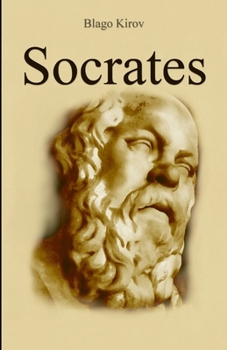
Socrates
No Customer Reviews

Socrates is to the West what Confucius is to China; centuries after him came Christ, but Christ is almost a legend, and Socrates is a real person. Besides being a great philosopher and thinker, he is also one of the greatest spiritual strategists of the West, because his death makes a complete fusion of his philosophy with his life, and this is already a moral law, even a moral constitution, by which we are guided today. His last battle was in court, and he won it epically. If we unfold the history of the West not as a chronicle of dry events but as a gigantic chessboard of the spirit, we will discover that the greatest victories are not won by generals in iron armor but by people possessing the supreme, almost superhuman art of cool calculation. On that spring morning in 399 BC, in the Athenian courtroom, not just a provincial trial for religious blasphemy was playing out; there, the moral constitution of our world was being forged. Socrates stands before his 501 judges with the clear mind of a strategist who calculates his moves millennia ahead. He sees Anytus, Polycrates, and Meletus - these figures of the moment, confined to the narrow space of their time. They think of tomorrow, of the market, of the voices of the Agora. Socrates, however, looks to the distant horizon of centuries. He knows that for the civilized world, his figure must become the eternal, unshakeable cornerstone of thought and statecraft. But unlike Christ, who would later step into history shrouded in the mists of myths and legends, Socrates remains to the end a painfully real person - flesh, bone, will, and pure intellect. Socrates' last battle in court is a masterpiece of asymmetrical warfare. He does not take the podium to defend himself. Defense is an acknowledgment of the court's right to judge you. Defense is an attempt to save the temporary body. Socrates does the opposite: he attacks the very matrix of Athenian justice. When he refuses to beg for mercy and instead demands triumph, he makes the perfect strategic move. He puts the judges in a stalemate situation. This is an epically won battle because through it, Socrates achieves something no sophist or demagogue could buy with all the gold in the world: a complete, indivisible fusion of his philosophy with his purpose. If Socrates had remained silent, his dialogues would have gone down in history as brilliant intellectual exercises. If Socrates had fled, his irony would have withered in exile, turning him into just another aging rhetor. But by choosing death, he makes his words flesh. He steps out of the territory of "opinion" (doxa) and enters the territory of moral law. From that moment on, no one could say that his teaching was merely an abstract intellectual game - he proved it with the cup of poison. This is the moment when philosophy ceases to be a profession and becomes a constitution of the spirit. In this epic finale of his, there is not a drop of sentimentality or weakness. It is the cold, clear triumph of the individual over the collective madness of the crowd. We today - reading texts, reflecting on history, trying to find meaning in chaos - still move along the coordinates that this barefoot moral prophet drew on the plateau of Attica. Every time a person refuses to compromise with the truth for the sake of expediency, every time the scalpel of analysis cuts through the convenient lie of the day, Socrates wins his trial again and again. Anytus got the corpse. The sophists got the money for their speeches. Socrates got eternity. What today's rational, complex world calls by the cool legal term "the rule of law" is, in its deep, intimate essence, the political legacy of the Athenians. It was not born in the offices of modern constitutionalists but in a damp Athenian crypt, where a philosopher was faced with the ultimate choice: to save himself by trampling on principle or to save principle by self-destruction.
Format:Paperback
Language:English
ISBN:B0HB479SRH
ISBN13:9798185250242
Release Date:July 2026
Publisher:Independently Published
Length:114 Pages
Weight:0.31 lbs.
Dimensions:0.3" x 5.5" x 8.5"
Customer Reviews
0 rating
Copyright © 2026 Thriftbooks.com
Terms of Use | Privacy Policy | Do Not Sell/Share My Personal Information | Cookie Policy | Cookie Preferences | Accessibility Statement
ThriftBooks ® and the ThriftBooks ® logo are registered trademarks of Thrift Books Global, LLC
ThriftBooks ® and the ThriftBooks ® logo are registered trademarks of Thrift Books Global, LLC
