


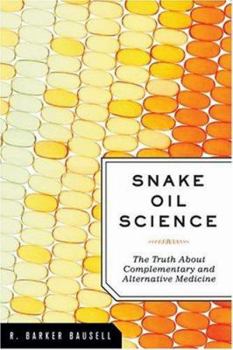
Snake Oil Science: The Truth about Complementary and Alternative Medicine

Select Format
Select Condition 
Book Overview
Millions of people worldwide swear by such therapies as acupuncture, herbal cures, and homeopathic remedies. Indeed, complementary and alternative medicine is embraced by a broad spectrum of society, from ordinary people, to scientists and physicians, to celebrities such as Prince Charles and Oprah Winfrey.
In the tradition of Michael Shermers Why People Believe Weird Things and Robert Parks's Voodoo Science, Barker Bausell provides an engaging look at the scientific evidence for complementary and alternative medicine (CAM) and at the logical, psychological, and physiological pitfalls that lead otherwise intelligent people--including researchers, physicians, and therapists--to endorse these cures. The books ultimate goal is to reveal not whether these therapies work--as Bausell explains, most do work, although weakly and temporarily--but whether they work for the reasons their proponents believe. Indeed, as Bausell reveals, it is the placebo effect that accounts for most of the positive results. He explores this remarkable phenomenon--the biological and chemical evidence for the placebo effect, how it works in the body, and why research on any therapy that does not factor in the placebo effect will inevitably produce false results. By contrast, as Bausell shows in an impressive survey of research from high-quality scientific journals and systematic reviews, studies employing credible placebo controls do not indicate positive effects for CAM therapies over and above those attributable to random chance.
Here is not only an entertaining critique of the strangely zealous world of CAM belief and practice, but it also a first-rate introduction to how to correctly interpret scientific research of any sort. Readers will come away with a solid understanding of good vs. bad research practice and a healthy skepticism of claims about the latest miracle cure, be it St. John's Wort for depression or acupuncture for chronic pain.
In the tradition of Michael Shermers Why People Believe Weird Things and Robert Parks's Voodoo Science, Barker Bausell provides an engaging look at the scientific evidence for complementary and alternative medicine (CAM) and at the logical, psychological, and physiological pitfalls that lead otherwise intelligent people--including researchers, physicians, and therapists--to endorse these cures. The books ultimate goal is to reveal not whether these therapies work--as Bausell explains, most do work, although weakly and temporarily--but whether they work for the reasons their proponents believe. Indeed, as Bausell reveals, it is the placebo effect that accounts for most of the positive results. He explores this remarkable phenomenon--the biological and chemical evidence for the placebo effect, how it works in the body, and why research on any therapy that does not factor in the placebo effect will inevitably produce false results. By contrast, as Bausell shows in an impressive survey of research from high-quality scientific journals and systematic reviews, studies employing credible placebo controls do not indicate positive effects for CAM therapies over and above those attributable to random chance.
Here is not only an entertaining critique of the strangely zealous world of CAM belief and practice, but it also a first-rate introduction to how to correctly interpret scientific research of any sort. Readers will come away with a solid understanding of good vs. bad research practice and a healthy skepticism of claims about the latest miracle cure, be it St. John's Wort for depression or acupuncture for chronic pain.
Format:Hardcover
Language:English
ISBN:0195313682
ISBN13:9780195313680
Release Date:October 2007
Publisher:Oxford University Press
Length:352 Pages
Weight:1.26 lbs.
Dimensions:1.2" x 6.3" x 8.5"
Customer Reviews
5 ratings
An excellent treatise on the science of clinical trials
Published by Thriftbooks.com User , 17 years ago
I am a practicing physician in Singapore and at one time, on staff teaching hematology in University College Hospital Medical School, London University and then Hong Kong University. Many years ago, while sitting on the Singapore National Medical Research Council, there was one grant applicatioin that asked for money to do a piece of research on "Acupuncture for the relief of osteoarthritic knee pain." There was no sham acupuncture control group mentioned. When I said in order to make the trial valid, there must be a control group. The answer came back, "We know no matter where we stick the needle, the pain will improve." That started me on my quest for more knowledge regarding acupuncture and other forms of Complementary and Alternative Medicine (CAM). This book by R. Barker Bausell is the best one I have ever read. Bausell is a biostatistician, a Professor at the University of Maryland and at one time Research Director of an NIH funded CAM Specialized Research Center. The structure of the book could roughly be outlined as an attempt to finding answers to the following questions: 1. Is there such a thing as a therapeutic placebo effect? 2. Is there a plausible biochemical analgesic mechanism of action that could explain such an effect? 3. Is there such a thing as a CAM therapeutic effect over and above what can be attributed to the placebo effect (assuming that there is such a thing as the latter)? 4. Are there plausible biochemical mechanisms of action that could explain these CAM therapeutic effects (assuming there are such things)? In the process of answering those questions, he explained in very clear terms the necessity for Randomized Control Trials (RCT), and preferably Double blinded RCT, where neither the physician nor the patient knew whether the patient was receiving the treatment or just a placebo, was necessary. As an aside, his book could be an introductory treatise on running RCTs for the rookie clinical research working planning his/her first clinical trial. Towards the end of the book, having laid out the criteria of what were meant to be good clinical trials, he found virtually nothing in the literature that pointed to the efficacy of CAM other than that due to placebo effects. In summary his answers to those four questions posed at the beginning are: 1. The placebo effect is real and is capable of exerting at least a temporary pain reduction effect. It occurs only in the presence of the belief that an intervention (or therapy) is capable of exerting this effect. This belief can be instilled through classical conditioning, or simply by the suggestion of a respected individual that this intervention (or therapy) can reduce pain. 2. The placebo effect has a plausible, biochemical mechanism or action (at least for pain reduction), and that mechanism of action is the body's endogenous opiod system. 3. There is no compelling credible scientific evidence to sugges that any CAM therapy benefits only medical condition or reduces any
A great explanation of why so many get hoodwinked
Published by Thriftbooks.com User , 18 years ago
Bausell does a great job in this book of explaining why Complementary and Alternative Medicine (CAM) is so popular, even though there's no good evidence that it works. To do this, he goes through several steps. He explains how both consumers and medical practitioners could be convinced of the efficacy of CAM when it's not there. He explains the basics of good research, especially using a placebo control. He shows how bad most CAM research is. He provides compelling evidence that the placebo effect, at least for pain relief, is a real, physiological phenomenon. And he pulls this all together to show that CAM is no more effective than placebo. I've seen criticisms that he lumps all CAM together. That's true, because every CAM technique suffers from the same two characteristics: there is no scientific basis for why it should work, and the research on it lousy. Most CAM therapies don't lend themselves towards placebo controls - how do you do a sham chiropractic adjustment? In fields such as homeopathy and acupuncture where there are good placebos, placebo-controlled trials are overwhelmingly negative. That's probably why most trials don't use placebos. Note that Bausell doesn't say that CAM doesn't work. On the contrary, he just says it's no more effective than placebo. Since placebo effects are real, CAM effects are real, and CAM practitioners can provide some real relief. Does that put them on a par with allopathic (mainstream Western) medicine, which can provide treatments that greatly exceed the placebo effect? Of course not. The book would have benefited from a discussion of how any CAM treatment that can survive quality research then ceases to be CAM. For example, he talks briefly about willow bark, which contains aspirin, and how it used to be an herbal remedy. There are other medicines or treatments that started as CAM and have moved into mainstream medicine as they were proven. This condemns CAM perpetually to be a wasteland of ineffective treatments. But Bausell doesn't really make that point, which I'm sure will leave some readers wondering if their local practitioner may this time have the miracle cure that's the one exception. But that's a minor criticism for a book that tackles a very ambitious topic. I heartily recommend this book to anyone who cares about their health or their health care dollar.
Expect a bi-modal rating for this book
Published by Thriftbooks.com User , 18 years ago
Those who appreciate any effort to improve critical thinking within the public will rate this book highly. Those who are CAM practitioners, researchers, or devotees will say that this is a simplistic book because it doesn't take into account the sophistication that their particular CAM therapy requires to understand its effect. Its worth repeating Bausell's conclusion: "CAM therapies are nothing more than cleverly packaged placebos." This is sure to annoy about 36% of the population.
Research Methodology Made Ridiculously Simple?
Published by Thriftbooks.com User , 18 years ago
Don't let the provocative title fool you - this book is not an emotional rant against CAM. Instead, the author explains - in wonderfully simple and convincing terms - the importance of reliable research, and the current lack thereof in the relatively new field of CAM. Bausell carefully reviews the common causes of false inferences, researcher and publication biases, and the placebo effects that can result in false positive results. He carefully explains the ways in which any research may be flawed, and how (to the untrained eye) it can be used to justify inappropriate conclusions. You will learn more about research pitfalls from this book than you will in medical school - and it is invaluable for those interested in determining the validity of research findings for themselves. The author carefully and methodically sets up the reader for his striking conclusion - that to date there have been no randomized, placebo-controlled trials published in top tier medical journals demonstrating that any CAM therapy is superior to placebo. Don't believe it? Better read the book for yourself. You won't regret it.
Understand how smart people support support questionable medical solutions
Published by Thriftbooks.com User , 18 years ago
This book helped me understand why some very smart people I know spend so much money on products I thought were of questionable value. The author minimizes the emotional and subjective by focusing on facts that have only recently been established, with emphasis on why alternative medical solutions help some individuals. I highly recommend to anyone trying to find a solution for complex, lingering medical problems. It will be a tremendous help for discussions with your medical advisor. Also recommend to anyone involved with friend and family considering new medications where you are concerned about their medications (whether recommended by a licensed physician, alternative medical advisor or from self help reading).
Copyright © 2026 Thriftbooks.com Terms of Use
| Privacy Policy | Do Not
Sell/Share My Personal Information | Cookie Policy | Cookie Preferences | Accessibility Statement
ThriftBooks® and the ThriftBooks® logo are registered trademarks of Thrift Books Global, LLC
ThriftBooks® and the ThriftBooks® logo are registered trademarks of Thrift Books Global, LLC
