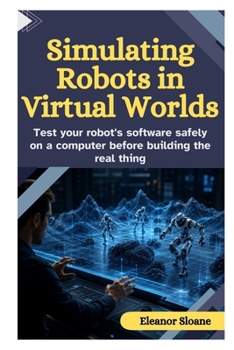
Simulating Robots in Virtual Worlds: Test Your Robot's Software Safely on a Computer Before Building the Real Thing

Building a robot in the real world is expensive, time-consuming, and sometimes risky.
A software mistake can damage equipment, waste hours of testing, or create unsafe behaviour. Robot simulation provides a controlled environment where engineers, students, and developers can test designs, evaluate software, and discover problems before moving to physical machines.
Simulating Robots in Virtual Worlds is a practical guide to using simulation as an engineering workspace for developing reliable robotic systems.
Rather than treating simulation as a simple animation, this book teaches you how to create measurable virtual experiments where robots can move, sense, plan, fail, recover, and improve.
You will learn how to build a complete simulation workflow:
Robot Model → Virtual Environment → Physics → Sensors → Controllers → ROS 2 Integration → Testing → Hardware Validation
The book uses ROS 2, Gazebo, URDF, Xacro, SDFormat, Python, and related robotics tools to demonstrate how modern robot software is developed before deployment.
Inside this practical guide, you will learn how to:
Understand what robot simulation actually calculatesDistinguish simulation from animation and digital twinsDecide what level of realism a project requiresSelect the right simulator for different robotics applicationsCompare Gazebo, Webots, NVIDIA Isaac Sim, CoppeliaSim, MuJoCo, and PyBulletBuild reproducible simulation environmentsInstall and validate ROS 2 and Gazebo workflowsCreate ROS 2 workspaces and packagesBuild virtual robot modelsDescribe robot links, joints, mass, inertia, and coordinate framesCreate robot descriptions using URDF and XacroUnderstand SDFormat world filesBuild realistic virtual environmentsAdd obstacles, objects, lighting, and collision geometryConfigure simulation physicsTune gravity, friction, contact behaviour, and joint dynamicsUnderstand simulation time and update ratesAdd cameras, LiDAR, IMUs, and other sensorsModel sensor noise, delay, bias, and missing readingsConnect robot software to virtual hardwareControl simulated wheels, joints, and actuatorsUnderstand differential-drive motionConfigure controllers and command interfacesIntegrate Gazebo with ROS 2Many robotics projects fail because testing begins too late.
Simulation allows developers to identify software errors before expensive hardware trials. However, this book also explains the limitations of simulation: virtual success does not replace physical validation. Real robots still introduce battery changes, mechanical variation, electrical noise, communication delays, and unpredictable environments.
By the end of this book, you will understand how to:
Create reliable virtual robotsDesign meaningful simulation experimentsTest robot software systematicallyImprove navigation and control systemsBuild repeatable robotics workflowsMove from simulation evidence to controlled hardware deploymentWhether you are a robotics student, ROS 2 developer, automation engineer, researcher, or robotics hobbyist, Simulating Robots in Virtual Worlds provides the practical foundation needed to develop better robots before building them in the real world.
Customer Reviews
ThriftBooks ® and the ThriftBooks ® logo are registered trademarks of Thrift Books Global, LLC