


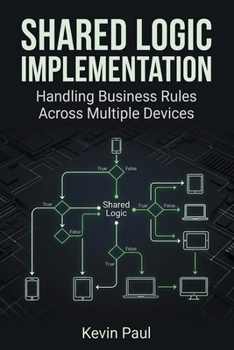
Shared Logic Implementation: Handling Business Rules Across Multiple Devices

Stop duplicating your business rules across multiple platforms.
In today's interconnected digital landscape, users expect seamless consistency whether they are on a smartphone, desktop, or web browser. Yet, development teams continue to build isolated silos for iOS, Android, and web, duplicating core domain rules and creating fragile, bug-prone systems.
Shared Logic Implementation: Handling Business Rules Across Multiple Devices provides a comprehensive blueprint for escaping the trap of tightly coupled architecture. This guide focuses entirely on the structural foundation of cross-platform development: isolating your core business rules from presentation layers and platform-specific infrastructure.
By treating your business logic as an independent, platform-agnostic engine, you can write your rules once, test them exhaustively, and deploy them everywhere with absolute confidence.
What you will discover inside:
Architectural Foundations: Master Clean Architecture and Hexagonal (Ports and Adapters) patterns to reverse dependencies and protect your domain.
Domain-Driven Design in Practice: Establish a ubiquitous language and build rich, immutable domain models, aggregates, and value objects.
Robust Validation Pipelines: Centralize cross-platform validation to guarantee data integrity before it reaches your databases.
State and Synchronization: Implement unidirectional data flow and offline-first architectures to handle network failures and complex data conflicts gracefully.
Security and Resilience: Secure your shared core from client-side tampering while implementing automated retries, circuit breakers, and graceful degradation.
Scaling and Deployment: Build automated pipelines tailored for shared libraries, manage semantic versioning, and execute safe refactoring strategies.
Whether you are a senior engineer rescuing a legacy codebase or an architect planning a new multi-device ecosystem, this book delivers the practical strategies required to build software that scales across current devices and adapts instantly to the platforms of tomorrow.
Customer Reviews
ThriftBooks ® and the ThriftBooks ® logo are registered trademarks of Thrift Books Global, LLC
