


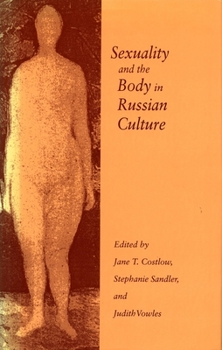
Sexuality and the Body in Russian Culture

Select Format
Select Condition 
Book Overview
A Stanford University Press classic.
Format:Hardcover
Language:English
ISBN:0804721130
ISBN13:9780804721134
Release Date:August 1993
Publisher:Stanford University Press
Length:372 Pages
Weight:1.30 lbs.
Dimensions:1.0" x 5.5" x 8.5"
Customer Reviews
1 rating
Book review
Published by Thriftbooks.com User , 21 years ago
Europe-Asia Studies, March, 1996 by Melanie Ilic The chapters which constitute this book were first presented at a symposium on sexuality in Russian culture held at Amherst College Russian Department in 1989. They cover a broad historical time frame, from the mediaeval to the modern, and examine representations of female sexuality and women's bodies from the perspectives of historical interpretation, cultural analysis, literary investigation and critical theory. The analytical framework of the essays draws greatly on the work of recent French feminist and cultural theorists, such as Foucault, whose writings on the history of sexuality have influenced work in this area for over a decade. The book also examines the ways in which women and men view sexuality and representations of the body differently and the authors draw here on British and American writings on 'the female gaze'. As such, this book provides an interdisciplinary text which utilises prominent Western critical theories to highlight the specifics of Russian cultural thinking in the area of female sexuality. The introduction to the book provides an extensive outline of a number of issues which influence our thinking on female sexuality: biology versus culture, the language of sex, the diverse range of sexualities, reproduction and sexual pleasure, bodily representations - '"women" dressed as "men"' (p. 22) and the changing and challenging perspectives on Russian sexuality which have emerged since the advent of glasnost'. Russian literary, political and cultural texts from the 19th and 20th centuries, now familiar to many Western readers, are used to illustrate the variety of debates on these issues. They clearly illustrate that Russia has never been a 'sexless' society or 'uninterested in the erotic' (p. 37). 'The papers in this volume demonstrate that the "erotic questions" have always been present in the history of Russian culture, even when they have been most vehemently denied' (pp. 37-38). The introduction also poses the question 'how does "Russian" sexuality differ from that of the "West"?' (pp. 4-8) and signals the importance of the overall theme of the individual chapters for contemporary rewritings and redrawings of Russian sexuality. Eve Levin argues in the first chapter that 'an understanding of how mediaeval Russian high culture viewed sexuality becomes a necessary first step for the analysis of sexuality in modern Russia' (p. 52). Most of the chapters which follow adopt an overtly feminist perspective in their analysis of such topics as puppet theatre, vanguard art, the ideological battlegrounds of reproduction and maternity and lesbian sexuality. The authors do well to note some of the problems to which their own analysis gives rise. The very framework of their debates may be meaningless to many potential Russian readers. Diana Burgin, for example, points out that 'whatever contributions Lesbians have made to Russian feminism have either not been noted by historians
Copyright © 2026 Thriftbooks.com
Terms of Use | Privacy Policy | Do Not Sell/Share My Personal Information | Cookie Notice | Cookie Preferences | Accessibility Statement
ThriftBooks ® and the ThriftBooks ® logo are registered trademarks of Thrift Books Global, LLC
ThriftBooks ® and the ThriftBooks ® logo are registered trademarks of Thrift Books Global, LLC
