


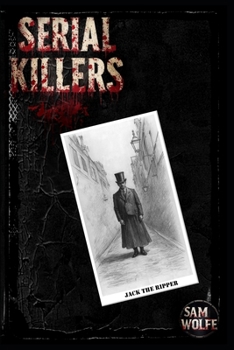
Serial Killers: : Jack the Ripper
No Customer Reviews

Jack the Ripper is the name given to an unidentified serial killer who terrorized the Whitechapel district of London's East End in 1888. He was never caught, and his identity remains one of history's most famous unsolved mysteries. The Context In 1888, Whitechapel was one of the poorest and most overcrowded areas of London. Poverty, crime, and prostitution were rampant. Between August and November of that year, a series of brutal murders of women shocked the city and dominated the national press, creating a media frenzy that essentially invented modern tabloid crime coverage. The name "Jack the Ripper" came from a letter sent to the Central News Agency at the time, signed "Jack the Ripper," claiming to be the killer. Historians believe the letter was likely a hoax by a journalist, but the name stuck. The Victims While many murders occurred in Whitechapel around that time, police and historians generally agree on five "canonical" victims attributed to the same killer: 1. Mary Ann Nichols - August 31, 1888
2. Annie Chapman - September 8, 1888
3. Elizabeth Stride - September 30, 1888
4. Catherine Eddowes - September 30, 1888 - killed the same night as Stride in what became known as the "double event"
5. Mary Jane Kelly - November 9, 1888 All were women with connections to prostitution, living in extreme poverty. The attacks typically occurred late at night or in the early morning hours, in dark alleys or in the victims' own rooms. The Murders and Investigation The killer's method involved cutting the throats of his victims and then mutilating their abdomens. The increasing severity of the mutilations, particularly in the case of Mary Jane Kelly, led police surgeons of the time to believe the killer had some anatomical knowledge or surgical skill. The investigation was led by the Metropolitan Police and Whitechapel's H Division. Despite interviewing hundreds of people, following thousands of leads, and facing immense public pressure, the police lacked modern forensic tools. The case was hampered by poor policing methods of the era, anti-Semitic rumors, and sensationalist press interference. Suspects and Theories More than 100 suspects have been named over the last 135+ years. A few of the most frequently discussed include: * Montague John Druitt - a barrister and schoolteacher
* Aaron Kosminski - a Polish immigrant barber who lived in Whitechapel
* Severin Klosowski - also known as George Chapman, a Polish surgeon who later became a serial poisoner More recent theories have used DNA analysis on a shawl allegedly belonging to Catherine Eddowes, with some researchers pointing to Kosminski, but that evidence is highly disputed by other experts and not considered conclusive. Because the killer was never identified, theories have ranged from a member of the Royal Family, to a doctor, to a local butcher, to an American. The Legacy Jack the Ripper was not the first serial killer, but he was the first to become a global media phenomenon. The failure to catch him led to reforms in London policing and helped shape how the press covers crime. His story has become an industry of books, films, tours of Whitechapel, and amateur sleuthing called "Ripperology," but for historians, the case is primarily remembered as the tragic story of five vulnerable women whose lives were cut short in Victorian London.
2. Annie Chapman - September 8, 1888
3. Elizabeth Stride - September 30, 1888
4. Catherine Eddowes - September 30, 1888 - killed the same night as Stride in what became known as the "double event"
5. Mary Jane Kelly - November 9, 1888 All were women with connections to prostitution, living in extreme poverty. The attacks typically occurred late at night or in the early morning hours, in dark alleys or in the victims' own rooms. The Murders and Investigation The killer's method involved cutting the throats of his victims and then mutilating their abdomens. The increasing severity of the mutilations, particularly in the case of Mary Jane Kelly, led police surgeons of the time to believe the killer had some anatomical knowledge or surgical skill. The investigation was led by the Metropolitan Police and Whitechapel's H Division. Despite interviewing hundreds of people, following thousands of leads, and facing immense public pressure, the police lacked modern forensic tools. The case was hampered by poor policing methods of the era, anti-Semitic rumors, and sensationalist press interference. Suspects and Theories More than 100 suspects have been named over the last 135+ years. A few of the most frequently discussed include: * Montague John Druitt - a barrister and schoolteacher
* Aaron Kosminski - a Polish immigrant barber who lived in Whitechapel
* Severin Klosowski - also known as George Chapman, a Polish surgeon who later became a serial poisoner More recent theories have used DNA analysis on a shawl allegedly belonging to Catherine Eddowes, with some researchers pointing to Kosminski, but that evidence is highly disputed by other experts and not considered conclusive. Because the killer was never identified, theories have ranged from a member of the Royal Family, to a doctor, to a local butcher, to an American. The Legacy Jack the Ripper was not the first serial killer, but he was the first to become a global media phenomenon. The failure to catch him led to reforms in London policing and helped shape how the press covers crime. His story has become an industry of books, films, tours of Whitechapel, and amateur sleuthing called "Ripperology," but for historians, the case is primarily remembered as the tragic story of five vulnerable women whose lives were cut short in Victorian London.
Format:Paperback
Language:English
ISBN:B0H9W4ZWGC
ISBN13:9798188434564
Release Date:July 2026
Publisher:Independently Published
Length:364 Pages
Weight:0.97 lbs.
Dimensions:0.9" x 6.0" x 9.0"
Customer Reviews
0 rating
Copyright © 2026 Thriftbooks.com
Terms of Use | Privacy Policy | Do Not Sell/Share My Personal Information | Cookie Policy | Cookie Preferences | Accessibility Statement
ThriftBooks ® and the ThriftBooks ® logo are registered trademarks of Thrift Books Global, LLC
ThriftBooks ® and the ThriftBooks ® logo are registered trademarks of Thrift Books Global, LLC
