


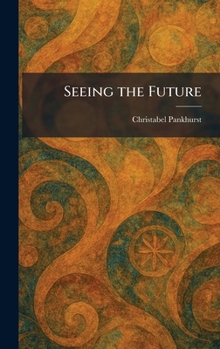
Seeing the Future

"Seeing the Future" explores the intersection of biblical prophecy and the state of the modern world through the lens of one of the twentieth century's most influential female leaders. Christabel Pankhurst, transitioning from her career as a militant political activist to a devoted biblical scholar, examines the signs of the times and the spiritual trajectory of humanity. The work delves into Christian eschatology, interpreting world events through the framework of scriptural predictions concerning the Second Coming of Christ.
Pankhurst argues that the complexities of global politics and social shifts are not mere coincidences but are foretold in the Bible. Her writing reflects a deep conviction in the relevance of ancient prophecy to contemporary life, offering a message of hope and divine providence amidst the uncertainty of the post-war era. "Seeing the Future" serves as a compelling testament to Pankhurst's theological shift and her commitment to sharing a vision of spiritual destiny. It remains a significant text for readers interested in the history of religious thought, the development of Adventist theology, and the diverse intellectual life of a prominent historical figure.
This work has been selected by scholars as being culturally important, and is part of the knowledge base of civilization as we know it. This work was reproduced from the original artifact, and remains as true to the original work as possible. Therefore, you may see the original copyright references, library stamps (as most of these works have been housed in our most important libraries around the world), and other notations in the work.
This work is in the public domain in the United States of America, and possibly other nations. Within the United States, you may freely copy and distribute this work, as no entity (individual or corporate) has a copyright on the body of the work.
As a reproduction of a historical artifact, this work may contain missing or blurred pages, poor pictures, errant marks, etc. Scholars believe, and we concur, that this work is important enough to be preserved, reproduced, and made generally available to the public. We appreciate your support of the preservation process, and thank you for being an important part of keeping this knowledge alive and relevant.
Customer Reviews
ThriftBooks ® and the ThriftBooks ® logo are registered trademarks of Thrift Books Global, LLC
