


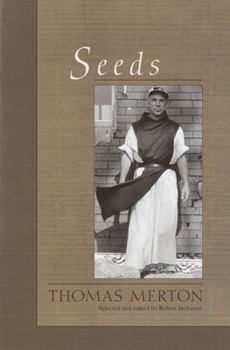
Seeds


"Thomas Merton is often considered the most prominent Christian contemplative of the twentieth century, but he was also a political activist, social visionary, and literary figure whose writings... This description may be from another edition of this product.
Format:Paperback
Language:English
ISBN:1570629307
ISBN13:9781570629303
Release Date:October 2002
Publisher:Shambhala
Length:192 Pages
Weight:0.63 lbs.
Dimensions:0.5" x 6.0" x 9.2"
Customer Reviews
2 ratings
Seeds for more thought
Published by Thriftbooks.com User , 21 years ago
I think this book works best if it's not read, but rather the paragraphs used as meditations to provoke thought. As Merton says "As soon as any thought stimulated your mind or your heart you can put the book down because your meditation has begun". Some of the selections and categorization of paragraphs may seem contrived, but the strength of this book is the strong and often poetic paragraphs (for example "Every blade of grass is an angel singing in a shower of glory"). Merton continues to provoke controversy in the Catholic Church, and was recently taken out of a new Roman Catholic handbook on church teachings. Some of the conservative critics are against the monk's later exploration of Buddhism, but the selections in this book clearly show there was never any question of Merton losing faith. The editor Robert Ichausti has selected various paragraphs from Thomas Merton's writings, and organized them topically. The first section "The Real and False Selves" states radical need. "If we follow nothing but our natures, our own philosophies, our own level of ethics, we will end up in hell". His understanding of the shadow self, reminded me of Jung. The second section "The World we live on", has thoughts about science and technology. Reading this in Louisville, I was struck by "Compare our monastery and the General Electric plant in Louisville. Which one is more serious and more "religious" institution?". Some of these paragraphs are influenced by Albert Camus and "The Myth of Sisyphus". The longest section on "Antidotes to Illusion" has meditations on truth, silence, prayer, and humility. Here is presented and utmost respect for silence "But there is no true intimacy between souls who do not know how to respect one another's solitude". There are paragraphs seemingly influenced by Kierkegaard. There is humility and "We must approach our meditation realizing that "grace", "mercy", and "faith" ... "are constantly renewed gifts". You will also be introduced to St. Benedict Joseph Labre, who lived a life of humility and poverty. Finally, I leave you with Merton's own admonition "Dance in this sun, you tepid idiot".
From The Merton Seasonal
Published by Thriftbooks.com User , 22 years ago
So, you think you've read Merton? Having enjoyed Robert Inchausti's wonderful and fresh presentation of Merton as an intellectual in Thomas Merton v American Prophecy (1997), I was excited to learn of his second book on Merton, simply titled Seeds. My excitement quickly faded, though, when I discovered that this second book would consist largely of quotations from Merton's oeuvre, and not new and original material from Inchausti's own pen. I thought: haven't we already read this? Then I began reading the book, my embarrassment growing with each turned page full of pearls. Inchausti has not merely selected and edited a fine collection of Merton's words, he has handcrafted a beautiful bracelet of precious jewels, each sparkling in its own right, but in this new setting the gems dazzle with spectacular brilliance. The book is resplendent. The book may be read (worn) any time of the day, for it works in a variety of ways for readers. For one, it serves as a good introduction to Meiton's thought, covering a range of themes presented in full paragraph-sized reflections, and includes both a concise yet colorful biographical essay by Inchausti and a short annotated bibliography of tapes and books for suggested further reading. Each quotation is followed by a parenthetical reference to the original work and (God bless Robert!) the page number. Thirty-five sources are used to supply the substantive quotations. A second way in which the book may be read is as a source for meditation; it should be read slowly, reflectively, and would be excellent for retreat purposes. It is technically possible to read this deceptively slim volume quickly, but that would greatly depend on how one defined the act of reading. It is more probable that one will read a page or two at the most, at one sitting, digesting slowly before the next meal hours or days later. Because the selections are arranged thematically. the book would serve well, too, as either a primary or supplemental text in courses, workshops or seminars on Merton. Four interconnected themes function as guides to Merton s approach to contemplative insight and cultural criticism, dividing the book into four parts: Part 1 deals with our "Real and False Selves"; Part II examines problems posed by the city, technology and pseudo-events in "The World We Live In"; Part III represents the largest grouping of passages, which are arranged as "Antidotes to Illusion" exemplified by truth, silence and humility, among others; Part IV deals with "Love In Action," particularly nonviolence. Inchausti appears concerned here with Merton s method of thinking, his intellectual hermeneutic, although he is wise not to imply that Merton worked through his reasoning processes like a technician. Giant themes loom large in Merton's mental sky, hut Inchausti's categorization is helpful in bringing them down to earth, reminding us that is so much still to learn and apply from Merton. Clearly, Merton was a teacher and Inchaus
Copyright © 2026 Thriftbooks.com Terms of Use
| Privacy Policy | Do Not
Sell/Share My Personal Information | Cookie Policy | Cookie Preferences | Accessibility Statement
ThriftBooks® and the ThriftBooks® logo are registered trademarks of Thrift Books Global, LLC
ThriftBooks® and the ThriftBooks® logo are registered trademarks of Thrift Books Global, LLC
