


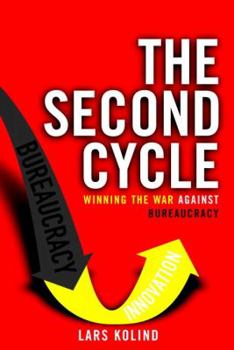
The Second Cycle: Winning the war against bureaucracy

Introducing a comprehensive guide to revitalizing mature organizations, Lars Kolind presents tools for creating consensus around change, using staff more effectively, promoting innovation, and much... This description may be from another edition of this product.
Format:Hardcover
Language:English
ISBN:0131736299
ISBN13:9780131736290
Release Date:April 2006
Publisher:Pearson P T R
Length:230 Pages
Weight:1.00 lbs.
Dimensions:9.5" x 1.0" x 6.3"
Customer Reviews
5 ratings
How to survive the paradigm shift from the transaction-based business model to the knowledge-based b
Published by Thriftbooks.com User , 18 years ago
The title refers to what Lars Kolind characterizes as an organizational re-design process by which to "enable and sustain innovation and growth. The starting point is the change from conventional mass production (for example, a metal parts factory) to knowledge work (for example, investment banking) in general and customization in particular. It argues that the conventional hierarchical and functional organization is long overdue as an adequate structure for organizations that perform knowledge work. [The re-design design process] highlights four fundamental characteristics of organizations that are essential if they want to exchange an upcoming death cycle [i.e. the first cycle] with a second or third lifecycle." Kolind suggests that such an organizational re-design process is needed because most (if not all) organizations are involved in (for lack of a better term) a paradigm shift from being transaction-based to knowledge-based. Kolind cites the rapidly increasing amount of available knowledge that becomes available, the competitive advantages that result from providing innovative and radically different solutions to problems, consumer perceptions that focus more on differentiated products and services ("Price-performance ratios are no longer the only criterion for purchase; environmental, emotional, ethical, and esthetical aspects play a greater role."), and one-time costs (e.g. R & D and marketing) become more important than unit manufacturing and transportation costs. These and other factors create all manner of challenges to which organizations must now respond if they are to adapt to changing environments while continuously applying knowledge in new ways to create innovations in products, processes, and service. In other words, free themselves from the "death cycle" by becoming what Koland characterizes as a "collaborative organization" at all levels and in all areas of their external as well as internal operations. Of course, that requires managers to see themselves as - and function as - stewards whose fiduciary obligations include the welfare of their associates whom they view as full partners. That also requires a different mindset in terms how everyone involved values what they do and how they do it. More specifically, in terms of what Kolind characterizes as the "meaning" of such initiatives. How does they benefit others? And how can we increase and improve those benefits? I was especially interested in how Kolind illustrates this important point, that if an organization is to become a true partner with all of its stakeholders, and especially with customers, there needs to be a meaning behind each action. Whatever a given organization's "meaning" may be, Roland suggests that it serves several significant functions: it provides overall guidelines for everything done, it determines the focus and direction of innovation, it is the "turning point" for all internal and external communications, and it determines the relevance of
Intriguing Call-to-Action to Revolutionize Change for Mature Companies Resting on Their Laurels
Published by Thriftbooks.com User , 19 years ago
Not too surprisingly, the perpetual dilemma faced by mature companies is stagnation. Author Lars Kolind, a former CEO of a Danish-based hearing aid company, lends his particular insight into what causes this ultimately devastating situation and why many organizations discover this stagnation far too late for their management teams to do anything about it. He paints a typical scenario in which a company develops a core business that becomes a seemingly dependable cash cow. At a certain point of perceived stability, the leadership seeks out opportunities to acquire other businesses with the surplus cash. This myopic direction may mean short-term profitability and productivity gains from the additional revenue streams and inevitable resizing, but it does so under the presumption of an unchanging market. The author also points out how some publicly traded companies pay out dividends or buy back shares in lieu of unavailable acquisition candidates. Kolind calls for nothing less than an organizational revolution in defining his concept of a second cycle in the book. Using the company he guided as CEO, Oticon, as an exemplary model, he calls for a new framework of thinking in a knowledge-based economy by: (1) finding meaning behind a company's business objectives; (2) having employees become co-owners; (3) developing a collaborative organization; and (4) moving from power-based management to values-based leadership. The most illuminating chapter is his stepwise identification of a comprehensive toolbox he deems as necessary for a successful transition. There are seven tools identified: -- (1) Break the Cycle (BTC) Index to assess if an organization is infected by the lifecycle disease -- (2) Mental Model Mapper (MMM) to analyze current mental models and come up with alternative ones -- (3) Value Identification Process (VIP) to help identify an organization's values and turn them into reality in practice -- (4) Consensus Creation Crash Process (CCCP) to build consensus about the values and their implementation -- (5) Knowledge-based People Management (KPM) to optimize staff resources -- (6) Innovation Powerhouse (IP) to convert the workplace into an environment that values new ideas -- (7) Change Process Tools (CPT) to move an entire organization from conventional to innovative habits He sees much of the problem with mature organizations lies in an inability to detect that there is a problem. The path of apparent success is familiar to most in the corporate world - companies start to grow in headcount, additional management layers are structured into the organization, more departments are added, procedures turn into standards that become more rigid over time, the business model becomes fossilized and unable to adapt to changing market conditions. What's more, because of the focus on short-term profitability and shareholder value, the management team generally remains adamant in maintaining the business model as is and not facing up to evolving custome
Innovate To Win
Published by Thriftbooks.com User , 19 years ago
"The Second Cycle: Winning the War Against Bureaucracy," has a lot of variety and its title containing the term "bureaucracy" may be misleading to some. "Innovation" is in the title also, and much more prominent on the cover, and the book. Chapters: 1. The first cycle: Why Success Breeds Failure 2. The Second Cycle: A New Paradign 3. Meaning 4. Partnership 5. From Hierarchy to Collaboration 6. Leadership 7. The Toolbox 8. Three Live Case Studies 9. Conclusion Appendix: how Oticon entered The Second Cycle. Each chapter has sub-chapters that reinforce the chapter topic. As a contemporary business book, it's for companies of all sizes and every industry. Author Lars Kolind provides numerous case studies, tables, some theory, and figures, for the work and business model of today where "most of those straightforward and well-defined jobs are gone" (Kolind, 67). These jobs have been relocated to countries with cheap labor. Robots and machines are now performing many of the tasks of what these low-cost workers are doing. This book also has a self-assessment profile and a questionnaire. Items detailed are the recruitment process, individual development of the employee, manager development, and org. development. Where is the best place for the innovative mentality to be nurtured and promoted today? Education: Kolind aptly notes it's the schools, and it starts with Primary Education. Focusing on individuality, finding strengths, creativity, and yes, "fun." Enter the "Knowledge Worker." This worker's job isn't narrowly defined, tasks are less controlled by management, individuality, creativity, and flexibility is a must. And, for this knowledge based worker, we need the KBM: Knowledge Based Management. People- management is not always knowledge management based. Kolind also provides a case study on labor unions (although they're declining) and notes union importance in our knowledge-based society. As the worker becomes an independent contractor we are again reminded that: "Employers are capitalists that look upon workers purely as production factor. Employers will use any means to maximize profit. They will hire and fire employees according to short-term need, and they will strive to pay minimum amounts per working hour" (Kolind, 161). And yes, the workers have their interests, also. It's a two-way relationship, but often not symbiotic in today's global world, that is flattening before us. Kolind gives specific examples of changing organization styles starting with the old Line Staff Organization style of the U.S. auto industry in the early 20th Century. From heuristic bureaucratic theorist Max Weber, line staff separates employees and specialists in a hierarchical relationship. The benefits of line are: constant, high-quality output, minimal training cost, etc. Obviously in some industries this is most optimum. For other industries, it isn't. The 'Innovation and Mass Customization' style is for R & D, cust
Fight Tomorrow's Bloat
Published by Thriftbooks.com User , 19 years ago
Many have wondered how once nimble and creative organizations transform themselves into complacent, bloated bureaucracies. The bigger question is why managers remain blind to the deterioration long after it is obvious to many. Lars Kolind, the driver of Oticon's turn-around that lead to its assuming leadership in the world's hearing aid market, offers four thoughts to avoid bloat in this well-written book. He: 1. Analyzes the mechanism of the conventional corporate lifecycle. 2. Proposes four pillars for a new platform of innovation and growth that he calls the second cycle: Meaning, Partnership, Collaboration and Leadership. 3. Offers a grab bag of seven tools he used to diagnose your organization and establish a new foundation for it. 4. Illustrates his points with three case studies. The book is readable, actionable, specific and actionable. You cannot ask for much more from a book that retails for less than $18.00.
Interesting techniques to turn around a business.
Published by Thriftbooks.com User , 19 years ago
Lars Kolind became CEO of a company that desparately needed turning around, and as CEO he was able to do just that. In doing so he came up with a method of analyzing companies that takes into account their products, customers, workers, and several other aspects. All in all this seemed like an excellent approach. Then he applied these techniques to three 'industries' badly in need of turning around: the primary school system, labor unions, General Motors. I find myself wondering if his techniques are capable of such monumental changes. Indeed I wonder if any techniques are capable of fixing these three areas. I find myself continuing to think more about General Motors than I do the other two. If you were CEO of GM, what could you do to fix it. He says the challenge for the U.S. automobile industry is to produce transportation that is environmentally sustainable, yet safe, fast, reliable, comfortable, and fun! That's a pretty tall order. One thing he says is that by 2020 automobiles will be hydrogen powered. If that is true, then the obvious is to start pouring research money into hydrogen power, to get some of the crucial patents, processes and procedures developed, etc. But suppose that hydrogen power doesn't turn out to be the answer (big problem - where do you get the hydrogen), then all of your research and planning effort is waste. The problems with turning around GM are huge. There's a $2,000 per car cost in paying the retirement/medical/social costs for employees. Can any company sustain that in face of world competition? What about producing a 100 mpg car, a really light, gasoline/electric car? Rail travel is 3 to 5 times more efficient than road travel, should GM work to develop new techniques of rail travel, i.e. piggyback truck/automobile? But then again, GM just sold their locomotive division. What about moving production overseas? I understand they have big plans for Chinese factories. The real question is: In the face of running out of oil, is there a future for the automobile industry at all? If not, then how do you take the tremendous resources that GM has and develop an entirely new business? Applying Mr. Kolind's techniques to change GM requires some real effort at predicting the future. The techniques themselves are good, but sometimes there are fundamental swings in the market. GM was a major supplier of locomotives, but what happened to those big, well managed companies that made steam locomotives? Could they have been changed?
Copyright © 2026 Thriftbooks.com Terms of Use
| Privacy Policy | Do Not
Sell/Share My Personal Information | Cookie Policy | Cookie Preferences | Accessibility Statement
ThriftBooks® and the ThriftBooks® logo are registered trademarks of Thrift Books Global, LLC
ThriftBooks® and the ThriftBooks® logo are registered trademarks of Thrift Books Global, LLC
