


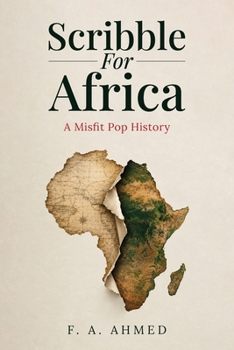
Scribble For Africa: A Misfit Pop History

Africa did not begin when outsiders arrived. Its story should not begin there either.
In Scribble for Africa: A Misfit Pop History, F. A. Ahmed challenges the histories, images and assumptions that have taught the world to see a continent through someone else's eyes. Who wrote the familiar story of Africa? What did they leave out? And why do so many of their ideas survive long after the empires that promoted them?
In Scribble for Africa: A Misfit Pop History, F. A. Ahmed confronts the stories that made conquest sound like civilization, extraction look like development, and an entire continent appear to be waiting for somebody else to arrive.
The journey begins before the "discovery" with African kingdoms, trading cities, scholarship and systems of government. It moves through the slave ship, the colonial office and the independence speech, then follows the old assumptions into their newer clothes: the news headline, the Hollywood film, the aid campaign, the classroom and the mirror.
Along the way, Ahmed follows the money and interrogates the excuses. Why does Africa so often enter the news only when something is burning? Who decided which languages belonged in a classroom and which faces belonged on a beauty poster? How did the people who took so much become so accomplished at describing themselves as people who gave?
But nobody gets a free pass. Not the empire. Not the well-meaning saviour. Not the African leader who wears liberation like a lifetime exemption from accountability.
This is neither a plea for pity nor a continent-sized alibi. Ahmed turns the same critical eye on corruption, gender inequality, failed leadership and the temptation to import answers while ignoring knowledge close to home. The past matters. Responsibility cannot be outsourced.
Nor is Africa's story exhausted by what was done to her. These pages make room for intellect, invention, local institutions and stubborn ingenuity: people governing, creating, solving problems and imagining futures that do not require somebody else's permission.
Fierce, irreverent and threaded with biting humour, Scribble for Africa brings history into the uncomfortable intimacy of everyday life. A map becomes an argument about power. A charity appeal becomes a question about who gets to be the hero. A familiar phrase in a blockbuster movie starts to sound less innocent than it did five minutes ago.
It does not offer a spotless African past or another comforting mythology. It offers something more demanding: a continent restored to the centre of its own story, with its achievements, contradictions and responsibilities intact.
Read this book for the history. Stay for the unexpected connections, the uncomfortable questions and the moments that make you laugh before you realize why you are angry.
You may arrive thinking you know the story. You may leave wondering who taught it to you, what they left out, and why you never thought to ask.
Customer Reviews
ThriftBooks ® and the ThriftBooks ® logo are registered trademarks of Thrift Books Global, LLC
