


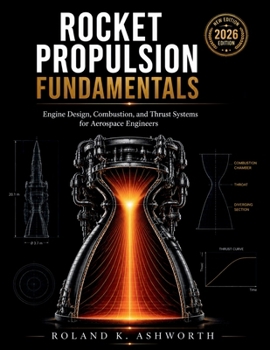
Rocket Propulsion Fundamentals 2026: Engine Design, Combustion, and Thrust Systems for Aerospace Engineers

Most rocket propulsion textbooks teach you to plug numbers into formulas. Almost none teach you why the formula exists - which is why so many aerospace engineering students can pass the exam and still freeze the first time a real nozzle design doesn't behave.
If you've stared at an engine cycle diagram, a regenerative cooling channel, or a combustion instability chart and felt the physics vanish behind a century of historical fixes and unexplained conventions, you don't need more formulas. You need a rocket propulsion textbook that shows its work.
Rocket Propulsion Fundamentals 2026 rebuilds rocket engine design from first principles - conservation of momentum, compressible flow, and chemical equilibrium - using tools you already have from a standard thermodynamics and fluid mechanics sequence. Unlike propulsion references organized around historical hardware, this book follows the logic of the physics itself: every derivation states its assumptions, every equation defines its variables and units, and every worked numerical example is carried through in full so no result is a black box.
Inside, 15 chapters take you from foundations to flight hardware:
The rocket equation and mission Δv budgetsNozzle theory and designCombustion thermochemistry and liquid propellant selectionEngine power cycles, turbopumps, and feed systemsThrust chamber cooling, heat transfer, and combustion instabilitySolid, hybrid, electric, nuclear, and advanced propulsionStaging, vehicle integration, and testingBuilt for how engineers actually learn:
Practice problems with a full answer key at the end of every chapterPropellant data tables, isentropic flow tables, and physical constants in the appendicesA complete symbol list and glossary for fast reference460+ pages covering chemical, electric, and nuclear propulsion in one consistent frameworkWho this book is for: upper-level undergraduates in aerospace or mechanical engineering, and practicing engineers moving into propulsion from an adjacent discipline. It assumes a first course in thermodynamics, fluid mechanics, and dynamics - and nothing else; any outside result is restated before it's used.
Who it's not for: readers wanting a qualitative, non-technical overview of how rockets work. This is a derivation-first engineering text with tracked units and worked math throughout.
Stop memorizing formulas you don't trust. Start understanding the engine - from the momentum principle to the launch pad.
Get your copy of Rocket Propulsion Fundamentals 2026 today.
Related Subjects
Engineering Science Science & Math Science & Scientists Science & Technology TechnologyCustomer Reviews
ThriftBooks ® and the ThriftBooks ® logo are registered trademarks of Thrift Books Global, LLC
