


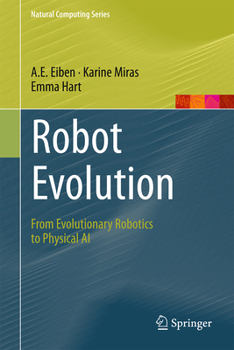
Robot Evolution: From Evolutionary Robotics to Physical AI

This book synthesizes the state of the art in the science and technology of robot evolution. It explores the principle "If evolution can create intelligence, artificial evolution can create artificial intelligence". It centers on embodied AI, where intelligence emerges from the interaction between a physical body and its environment, as exemplified by robots. The long-term vision is a new class of intelligent machines that evolve, learn, and improve both their bodies and their brains 'on the job'.
Designed as both an accessible entry point for students and a comprehensive reference for experts, the book is rich in case studies, design patterns, and adaptable algorithmic recipes that readers can reuse and extend. Written as a didactic guide, it supports both self-study and teaching. To bridge theory and practice, the book is accompanied by open-source software for experimentation, prototyping, and reproducible research.
Students in artificial intelligence, computer science, robotics, and related fields will find this volume a clear and structured introduction, while researchers, AI experts, roboticists, and biologists can use it as a valuable reference work and an inspiration for their research.
Customer Reviews
ThriftBooks ® and the ThriftBooks ® logo are registered trademarks of Thrift Books Global, LLC
