


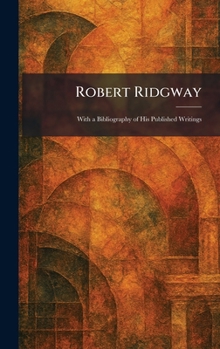
Robert Ridgway: With a Bibliography of His Published Writings

"Robert Ridgway With a Bibliography of His Published Writings" is a comprehensive tribute to one of the most significant figures in the history of American ornithology. As the first curator of birds at the United States National Museum, Robert Ridgway's influence on avian taxonomy and systematic biology was peerless. This volume serves as both a biographical retrospective and a meticulous archival resource, documenting the intellectual journey and professional achievements of a man whose work defined the standards of the field for decades.
The heart of this work is an extensive bibliography of Ridgway's published writings, ranging from his landmark multi-volume series on the birds of North and Middle America to his foundational research on color nomenclature. By cataloging his vast output, this book provides scholars and naturalists with an essential roadmap to the evolution of ornithological science in the late 19th and early 20th centuries. It captures the spirit of a golden era of natural history and honors a legacy that continues to inform modern zoological study. This work is an invaluable reference for historians of science, bibliophiles, and anyone dedicated to the study of the natural world.
This work has been selected by scholars as being culturally important, and is part of the knowledge base of civilization as we know it. This work was reproduced from the original artifact, and remains as true to the original work as possible. Therefore, you may see the original copyright references, library stamps (as most of these works have been housed in our most important libraries around the world), and other notations in the work.
This work is in the public domain in the United States of America, and possibly other nations. Within the United States, you may freely copy and distribute this work, as no entity (individual or corporate) has a copyright on the body of the work.
As a reproduction of a historical artifact, this work may contain missing or blurred pages, poor pictures, errant marks, etc. Scholars believe, and we concur, that this work is important enough to be preserved, reproduced, and made generally available to the public. We appreciate your support of the preservation process, and thank you for being an important part of keeping this knowledge alive and relevant.
Customer Reviews
ThriftBooks ® and the ThriftBooks ® logo are registered trademarks of Thrift Books Global, LLC
