


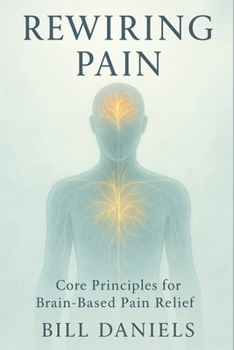
Rewiring Pain: Core Principals For Brain-Based Pain Relief

Why do some people live in pain long after an injury has healed-and why can a tiny paper cut feel worse than a major wound?
The answer lies not in muscles, joints, or tissue, but in the brain.
In Rewiring Pain, personal trainer and educator Bill Daniels takes you on a practical and eye-opening journey into how pain really works. After suffering a debilitating back injury that traditional methods couldn't fix, Bill shifted his career toward pain neuroscience-and has spent decades helping people finally understand why their pain persists and how to change it.
This book breaks down pain into clear, meaningful pieces so you can take control of your healing instead of guessing, hoping, or resigning yourself to discomfort.
What You Will LearnInstead of treating pain as a mechanical problem, you'll discover:
✔ Why pain is not always tied to tissue damage(And why the same injury can hurt two people differently)
✔ How your brain decides whether something should hurt(And how to influence that decision)
✔ The difference between mechanical pain, neurological pain, emotional pain, and threat-based pain(Chapter 3 gives you a "decoder ring" for understanding which is which)
✔ The key role receptors, nerves, the spine, and brainstem play in your pain experience(And how each system can be retrained)
✔ What parts of your brain amplify, maintain, or eliminate painIncluding:
Frontal lobe regulation
Parietal spatial awareness
Memory-based pain responses
The insular cortex-pain's integration hub
✔ Why accumulated life stressors form an "overflowing threat bucket"-and how to empty it
A Brain-First Roadmap to Feeling Better
Across 22 chapters, you'll learn:
How sensory pathways miscommunicate and exaggerate signals
Why certain cranial nerves directly influence pain perception
Why using opposite limbs or opposing joints can suppress pain responses
How lymphatic flow contributes to inflammation and discomfort
The exact roadmap Bill uses to assess and reduce pain (The TRACE Method)
Who This Book Is For
This book is ideal for anyone who:
Has persistent pain despite normal imaging
Has tried stretching, massage, or exercise with limited success
Wants a deeper understanding of their symptoms
Wants a science-based, actionable model for recovery
Whether you're newly injured, dealing with chronic pain, or supporting others professionally, this book offers clarity, empowerment, and direction.
Why This Book Is DifferentYou are not given generic exercises or temporary fixes-instead, you learn:
How pain is constructed
What the brain is trying to protect you from
How to change the signal at its origin
Through neuroscience research, real-world examples, and practical techniques, Rewiring Pain shows that pain is not a permanent state-it is a message. And messages can be rewritten.
If you want to understand your pain instead of guessing, hoping, or just coping, this book gives you the science, the clarity, and the framework to finally move toward relief-one rewired signal at a time.
Customer Reviews
ThriftBooks® and the ThriftBooks® logo are registered trademarks of Thrift Books Global, LLC
