


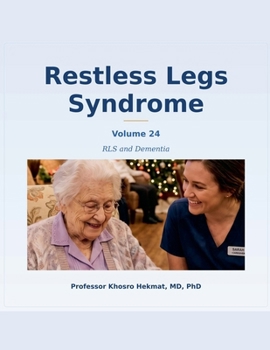
Restless Legs Syndrome - RLS and Dementia

Two questions that are constantly confused, answered one at a time.
Will I become demented because I have restless legs? Many people who have slept badly for years notice that names escape them, then read a headline about sleep and dementia and draw their own conclusion. At the other end of the same subject stands a daughter whose father has Alzheimer's disease and gets up every evening, walks about and cannot be calmed. She has been told this is the illness. It could also be something else, and treatable.
This volume keeps the two questions apart. On the risk, the largest study followed 12,478 people over sixty for twelve years: 10.4 per cent of those with restless legs and 6.2 per cent of the comparison group received a dementia diagnosis. That is a measurable, small difference whose cause remains open, and about nine in ten people with restless legs went twelve years without the diagnosis. Vascular dementia was more strongly affected than Alzheimer's dementia, which points to the vessels as the route where something can be changed.
The most factual reassurance comes from a summary of 16 studies. In restless legs syndrome attention is impaired, memory is not. That is almost the opposite of the pattern with which Alzheimer's disease begins, and the losses resemble those after a night without sleep.
The second question is the more urgent one. How do you recognise restless legs in a person with dementia who can no longer describe what they feel? The book presents a validated model of observation and medical history, explains what can lie behind evening agitation, and shows why the medication list is the fastest first move: in one study, 79 per cent of people with Alzheimer's dementia, night-time agitation and restless legs were taking at least one medicine that makes the legs worse.
The only controlled treatment trial, published in 2025, is described with its benefit and its price. In 147 people sleep time rose by 48 minutes, and adverse events were more common than on placebo. Before any medicine come two steps without one: reviewing aggravating medicines with the prescribing doctor and correcting iron deficiency.
WHAT IS IN THE BOOK
- Forgetful, slowed, confused: three words, three different things
- Why attention suffers in restless legs syndrome and memory does not
- How sleep loss differs from an incipient dementia
- The study of 12,478 people, and what a hazard ratio of 1.46 really means
- Why vascular dementia is more strongly affected, and what argues against a causal link
- What the brain needs sleep for, the nightly clearance and the protein that accumulates
- Iron: the same substance in two diseases, with opposite starting positions
- How common restless legs are in dementia, and why they almost always go unrecognised
- How relatives can recognise it when a father can no longer say so
- Agitation in the evening, and what can lie behind sundowning
- The medicines that make everything worse
- What you can do for your brain, and the honest balance at the end
WHO THIS BOOK IS FOR
For people with restless legs who worry about their memory, and for relatives and carers who want to make sense of evening agitation in a person with dementia and raise it with the doctor.
ABOUT THE SERIES
Volume 24 of 52 in the book series on restless legs syndrome, part "RLS with Other Conditions". Every volume can be read on its own. The statements in this volume rest on 175 professional sources, each one listed individually in the reference section.
Customer Reviews
ThriftBooks ® and the ThriftBooks ® logo are registered trademarks of Thrift Books Global, LLC
