


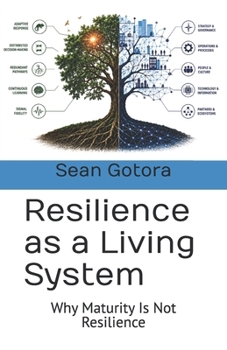
Resilience as a Living System: Why Maturity Is Not Resilience

Your organisation passed every audit. Your frameworks are ISO-compliant. Your plans are tested annually. So why would the next serious disruption still find you slow, fragmented, and reactive?
Because maturity is not resilience. For three decades, the profession has measured whether resilience capabilities exist, are documented, and are tested. It has not measured whether they work together under stress, and that is the only thing that determines whether an organisation survives disruption or merely survives the audit. An organisation can score at the highest level of a maturity model and remain systemically brittle.
Resilience as a Living System names that gap, explains exactly why it persists, and then does the harder thing: it builds the alternative. This is not a book of critique. It is a doctrine for designing resilience into how an organisation actually works.
Sean Gotora's central argument is deceptively simple: resilience is not a capability you own. It is a property of how your organisation is built. Capabilities can be staffed, scoped, and certified in isolation. Resilience emerges only from how those parts sense, signal, decide, and adapt together under stress, exactly the way living systems have survived for four billion years without a single framework between them.
Drawing on biology, from immune memory and distributed governance to redundancy, signal fidelity, and ecological succession, the book translates tested principles of survival into a practical doctrine for organisational design. This is no exercise in metaphor. Biological and organisational systems face the same fundamental problems: how to fail without collapsing, adapt without losing coherence, and learn from every disruption. The book treats biology's solutions as design specifications, not inspiration.
The argument is built across three acts:
Act I diagnoses the structural failures that keep "mature" organisations fragile, the efficiency trap, the authority gap in resilience functions, signal failure, and the false comfort of layered defence.Act II identifies the biological mechanisms that solve these problems, from decentralisation without chaos to the epigenetics of leadership, and translates each into organisational design.Act III builds the doctrine into practice: from risk registers to living systems, resilience as return rather than cost, and a final implementation layer that converts the argument into operating architecture, data models, and governance design.At its core is a three-part doctrine: Adaptive Strategy (the brain's capacity to reset objectives in a new environment), Agile Execution (the system's ability to act with speed and precision), and Integrated Learning (the immune memory that makes the next encounter survivable, not merely repeated). Crisis management and business continuity are not the doctrine. They are its reflex expression, and this book is the architecture that makes the reflex purposeful.
Who it's for: operational, financial, cyber, supply chain, brand, and strategic resilience practitioners, and the C-suite and board members who make the architecture decisions that determine whether any of it works. Each of the nineteen chapters stands on its own. Read in sequence, they build a cumulative case that is greater than the sum of its parts.
Written by Sean Gotora, a strategy, risk and resilience professional and board member of the Global Resilience Professional Body, the book reframes resilience from an assurance function into a design discipline: not predicting every disruption, but building organisations that sense it early, absorb it without collapse, and emerge stronger rather than merely intact.
The profession has spent thirty years getting more mature. This book is for the practitioners ready to get resilient.
Customer Reviews
ThriftBooks ® and the ThriftBooks ® logo are registered trademarks of Thrift Books Global, LLC
