


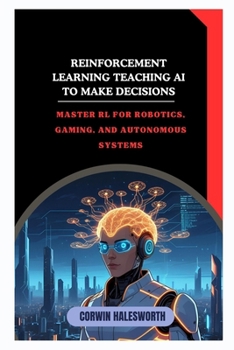
Reinforcement Learning Teaching AI to Make Decisions: Master RL for robotics, gaming, and autonomous systems

Teach machines to choose-and improve-on their own.
In Reinforcement Learning: Teaching AI to Make Decisions, you'll master the principles and practice of training agents that learn by trial, error, and reward. From classic control problems to high-stakes robotics and competitive games, this hands-on guide shows you how to turn objectives into policies, feedback into skill, and simulations into real-world performance.
Inside, you'll learn how to:
Frame problems as Markov Decision Processes (MDPs), define rewards that avoid "reward hacking," and pick the right state/action spaces.
Implement foundational methods-bandits, Monte Carlo, TD learning, Q-learning, SARSA-and know when each shines.
Build modern deep RL systems: DQN/Double-DQN/Dueling/NoisyNets, policy gradients, Actor-Critic, A2C/A3C, PPO, SAC, and TD3.
Boost stability and sample-efficiency with target networks, prioritized replay, advantage estimation, entropy regularization, and careful normalization.
Tackle hard exploration via ε-greedy schedules, UCB, curiosity/intrinsic rewards, and count-based methods.
Scale up with distributed training, curriculum learning, hierarchical RL, and multi-agent coordination.
Bridge the gap to reality using domain randomization, sim-to-real transfer, and safety constraints for robots and autonomous vehicles.
Apply offline RL, imitation learning (behavior cloning, DAgger), and inverse RL where data collection is costly or risky.
Evaluate and ship with reproducible experiments, ablations, metrics, seeding, and production-minded MLOps (monitoring, drift, rollback).
Featuring step-by-step projects in Python with Gymnasium, Stable-Baselines3, RLlib, PyTorch, and simulators like MuJoCo, CARLA, and AirSim, this book turns RL theory into reliable practice-so your agents learn faster, generalize better, and act safely.
Who This Book Is ForEngineers & researchers building RL for robots, drones, and autonomous systems
Game AI developers crafting adaptive enemies, allies, and strategies
Students & practitioners seeking a rigorous, practical path from basics to state of the art
Better decisions, made automatically. Train agents that learn-and keep learning.
Customer Reviews
ThriftBooks ® and the ThriftBooks ® logo are registered trademarks of Thrift Books Global, LLC
