


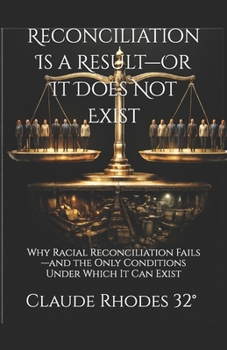
Reconciliation Is a Result-Or It Does Not Exist: Why Racial Reconciliation Fails-and the Only Conditions Under Which It Can Exist

What if racial reconciliation has been misunderstood from the very beginning?
For decades, conversations about race have focused on dialogue, diversity, inclusion, and understanding. These efforts are often presented as progress-evidence that reconciliation is happening.
But there is a critical problem:
None of these approaches define how reconciliation is measured.
In Reconciliation Is a Result-Or It Does Not Exist, Claude D. Rhodes 32 delivers a sharp, structured analysis that challenges one of the most widely accepted assumptions in modern society-that reconciliation is emotional, relational, or symbolic.
This book argues something far more precise:
Reconciliation is not a feeling. It is not a conversation. It is not an intention.
Reconciliation is a measurable outcome.
If outcomes are not consistent under the same conditions, reconciliation has not occurred-no matter what is said, promoted, or believed.
What This Book Reveals
This is not another opinion-driven discussion about race.
It is a systems-based breakdown of how outcomes are actually produced-and why most reconciliation efforts fail.
Inside, you will discover:
Why racial reconciliation has never been clearly defined-and why that guarantees failureHow laws change, but systems adapt to preserve outcomesWhy integration (shared space) does not equal reconciliation (shared results)How institutions-not individuals-determine outcomes across societyThe four structural reasons reconciliation efforts fail by designWhy trust cannot be built-and only emerges after consistent outcomes existHow media, education, and public narratives redirect attention away from systemic causesThe real structural barriers still producing unequal outcomes todayThe exact conditions required for reconciliation to existA step-by-step framework for measuring whether reconciliation is real-or just being claimedWhat Makes This Book Different
Most books talk about race through emotion, identity, or ideology.
This book does something different.
It defines reconciliation in operational terms and provides a clear, repeatable standard for evaluating it.
It does not ask:
Do people feel better?
Are conversations happening?
Is representation increasing?
It asks:
Are outcomes consistent under the same conditions?
That single question changes everything.
Who This Book Is For
This book is for readers who want clarity-not slogans.
It is for:
Readers seeking a non-emotional, structured analysis of racial reconciliationThinkers interested in systems, institutions, and outcome-based evaluationProfessionals, educators, and leaders who want to understand why efforts fail-and what would actually workAnyone tired of surface-level conversations and ready to examine how results are truly producedWhat You Will Gain
By the end of this book, you will have:
A clear definition of reconciliation that can be applied in any systemA framework for evaluating institutions based on outcome-not intentionThe ability to separate perception from measurable realityA deeper understanding of how systems produce consistent-or inconsistent-resultsThe Bottom Line
Reconciliation is not something that can be declared.
It is not something that can be assumed.
It is not something that can be described into existence.
Customer Reviews
ThriftBooks ® and the ThriftBooks ® logo are registered trademarks of Thrift Books Global, LLC
